


New neighbourhood noise laws came into force across NSW on 28 August 2026, giving councils, police and transport officers stronger tools to deal with noise complaints. The biggest change is that local authorities can now issue noisy vehicle owners with doubled on-the-spot fines.
The Protection of the Environment Operations (Noise Control) Regulation 2026 replaces the 2017 Regulation, following extensive consultation with communities and regulators led by the NSW Environment Protection Authority (EPA).
Vehicles: higher fines, increased liability
The main change is financial. Penalty amounts for a range of noisy vehicle offences have doubled, including for vehicles with defective or modified noise control equipment. The EPA says the previous penalties were too low, relative to comparable legislation, to actually deter offending.
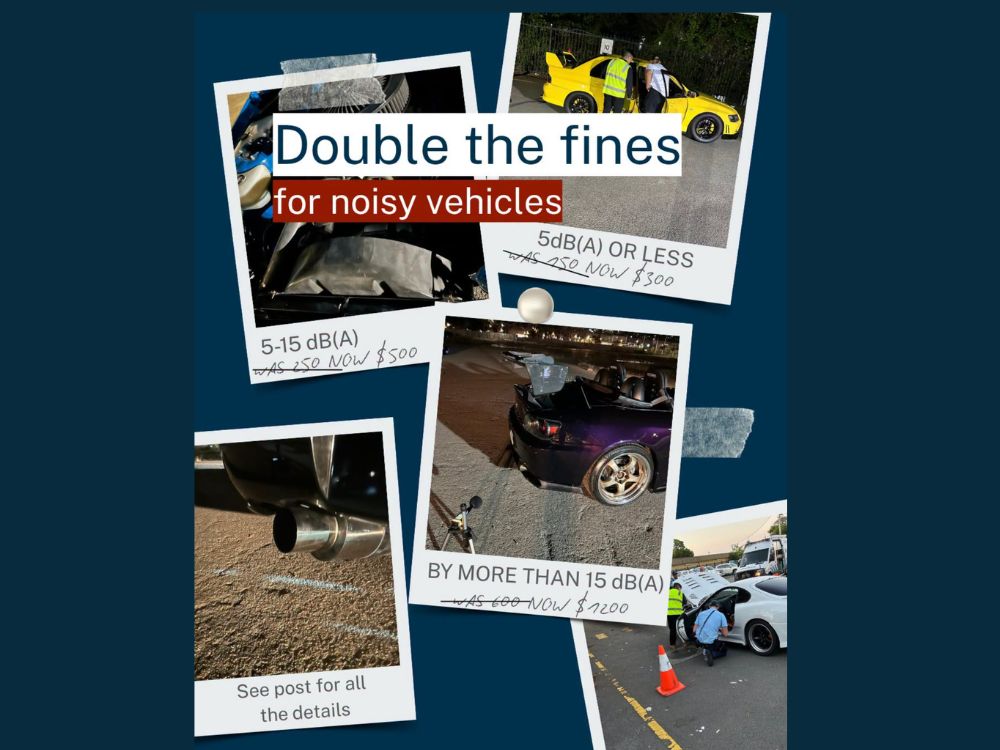
There’s also a new liability trap for landowners. Previously, only the driver or rider of an off-road vehicle (including trail bikes) could be held responsible for emitting offensive noise.
Under the new Regulation, the owner or occupier of the private land where the vehicle is being used can now also be liable, if they cause or permit that use.
On a more practical front, vehicles fitted with child presence detection (CPD) alarms, the emerging technology that alerts a driver if a child or animal has been left inside, are now exempt from the noise rules that otherwise restrict intruder alarms and horns.
Marine vessels
For anyone using Sydney’s waterways, the restriction on sounding a vessel’s siren, whistle, hooter, foghorn or bell has been broadened to cover all horns, except for navigation and emergency use.
The rules on amplified sound have also been extended beyond musical instruments and sound systems to include microphones, megaphones and other speech-amplification devices. Noise from entertainment on liquor-licensed vessels will now be managed the same way as licensed premises on land, under the Liquor Act framework.
Air conditioners and pumps: later curfews, heatwave exemption
This is the change most likely to affect everyday households. The night-time restricted hours for air conditioner use now start at 11 pm instead of 10 pm, and for pumps (other than heat pumps) at 9 pm instead of 8 pm this reflects that modern units run quieter than older models.
There’s also a new heatwave exemption. Time-of-use restrictions on air conditioners are lifted during periods of severe or extreme heatwave, as declared by the Bureau of Meteorology. The EPA points to the health risks of extended hot weather, particularly for vulnerable residents, as the reasoning here.
Equipment labelling simplified
Noise labelling requirements have been removed altogether for pavement breakers and mobile garbage compactors. NSW was the only state that still required them, and the EPA says there’s little evidence they cause significant noise impacts compared with unlabelled commercial equipment. Both are still covered by the general offensive noise provisions of the POEO Act.
Grass-cutting machines have also been simplified: they’re no longer a “prescribed article” under the POEO Act, the old two-category labelling system has been replaced with two label types to make compliance easier for manufacturers, and quieter autonomous battery-powered robot mowers are now exempt from labelling entirely.
What hasn’t changed: lawn mower and power tool hours
Despite the scale of these changes, one thing Lane Cove residents keep asking us about is untouched: The permitted hours for using lawn mowers, leaf blowers and other power tools have not changed.
The broad definition of “power tool” — covering petrol or electric-powered garden tools (mowers, trimmers, blowers, mulchers, edgers, chippers), electric and battery tools, pneumatic tools, chainsaws, circular saws, and gas or air compressors remains as it was under the 2017 Regulation, as does the timing of when they can be used.
So if a leaf blower fires up early on a Sunday morning, the same rules apply as before the update. You are only permitted to use power tools Monday to Friday: 8pm to 7am and Saturday, Sunday or Public Holidays: 8pm to 8am.
What to do about a noisy neighbour
T to your neighbour first. Most noise disputes get resolved at this stage. If it continues, Lane Cove Council can be brought in. If that does not work then it is off to court. Previously you could apply to the Community Justice Centre but from 1 July 2025, mediation through CJC is no longer available for disputes other than those referred by NSW Courts or involving incorporated associations.
Support Independent Community Journalism
Why local news matters
In the Cove delivers independent Lane Cove news every day, 100% free, with no paywall. We write for the community, from within the community.
We are a proud member of LINA, the Local and Independent News Association, which supports small, independent publishers serving their communities with reliable, accountable local journalism.
Local news strengthens community connection, keeps residents informed, spotlights issues that bigger outlets overlook, and holds local decision-makers accountable. When local news disappears, communities lose transparency, trust and shared understanding. Your support helps ensure Lane Cove continues to have a strong, independent voice.