

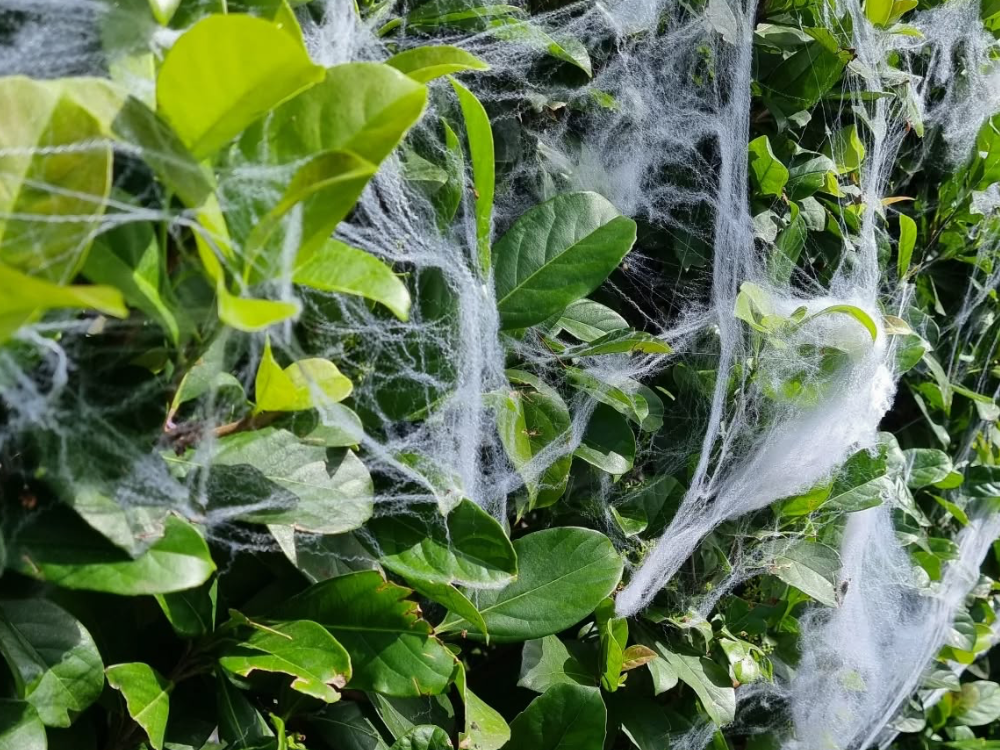
As Halloween decorations start appearing on Lane Cove letterboxes and hedges, the City of Marion in Adelaide has taken a step NSW hasn’t: a ban on synthetic spider webs. There’s no such ban here, but Lane Cove Council and BirdLife Australia have both asked in previous years that you to leave them on the shelf.
The Adelaide ban
The City of Marion has banned polyester or plastic artificial spider webs from public footpaths, verges, trees and fences. Residents can be fined up to $300.
The ban only applies to public council land. Residents are still legally allowed to put the decorations up on their own private property. You may not know this, but your verge is council property.
In mid-2025 City of Marion councillor Sarah Luscombe raised the decorations as an environmental concern, telling ABC Radio Adelaide that wildlife can become caught in the material very easily, and flagging that the council would review the issue.
It also fits South Australia’s track record. The state was the first in Australia to ban single-use plastic shopping bags in 2009 and has since added a steadily growing list of items, from plastic straws and cutlery to balloon sticks, confetti and even fish-shaped soy sauce bottles.
Why fake webs are a problem
The stretchy polyester webbing sold in supermarkets and discount stores each October doesn’t behave like real spider silk. It is much stronger, it doesn’t break when a bird or bat blunders into it, and the more an animal struggles the more tangled it becomes.
Timing makes it worse. In Australia, Halloween falls in the middle of spring breeding season. Many small birds, such as thornbills, silvereyes, fantails and wrens, use real spider silk to bind their nests and cannot tell the difference between the genuine article and the synthetic version.
BirdLife Australia and Humane World for Animals have both warned that the fibres can end up woven into nests, where chicks can become entangled or swallow them.
Researchers who study nests, including Macquarie University’s Professor Simon Griffith, have described finding plastic in nests and noted that fake cobweb appears to be particularly attractive to nest-building birds.
Bats, possums, flying foxes, lizards and insects are also at risk of entanglement. Because the material is plastic and doesn’t biodegrade, webbing that blows off a hedge in a spring storm can stay in the environment long after the pumpkins have been composted.
BirdLife Australia has been careful not to overstate things. Its spokesperson Sean Dooley has said reported entanglements remain relatively low, but that the number of webs going up grows every year, and that this is an easily avoidable hazard for garden birds whose numbers are already under pressure in the suburbs.
What about Lane Cove and NSW?
There is no equivalent ban in Lane Cove or NSW. Fake spider webs are not among the single-use plastic items phased out under the state’s plastics laws, and they remain widely available at major retailers.
That doesn’t mean local councils have been silent. Last October, Lane Cove Council posted a plea to residents getting ready to decorate: don’t forget about the local wildlife, especially birds. Council pointed out that fake spiderwebs and bits of string can find their way into nests, where they can tangle up chicks or be swallowed. Its advice, borrowed from BirdLife Australia, was to “go natural” with decorations and steer clear of fake spiderwebs, fishing line, rope, string, yarn, cotton wool and fruit tree netting.
Willoughby and Inner West councils have issued similar warnings, and some retailers have responded to the pressure. Woolworths has updated its packaging to recommend the webs be used indoors only.
In the Cove has raised this issue before, and the message hasn’t changed: legal isn’t the same as harmless.
What BirdLife Australia recommends
BirdLife Australia publishes a bird-safe Halloween guide each year, and its advice goes beyond spider webs. Scientists now estimate that around 30 per cent of Australian bird nests contain human-made materials. When birds weave non-biodegradable fibres like fishing line or polymer rope into a nest, nestlings are more likely to become tangled as they grow, which can cut off their circulation.
The fine threads in cotton wool and human hair carry the same entanglement risk, and so does fruit tree netting unless the mesh is 5mm x 5mm or smaller at full stretch.
BirdLife’s list is short and easy to remember.
Do use natural materials
- ✔ Straw
- ✔ Sheep’s wool
- ✔ Sticks and twigs
- ✔ Leaves and other organic garden waste
Don’t use
- ✖ Fake spiderwebs
- ✖ Fishing line
- ✖ Rope, string, twine or yarn
- ✖ Cotton wool
- ✖ Balloons
- ✖ Fruit tree netting
Cardboard cut-outs get a tick as a fun and safer alternative, and BirdLife has one bonus suggestion: decorate your windows. Birds can’t see glass, so covering the outside of a window with high-contrast ghosts and bats (no more than 5 to 10cm apart) doubles as bird-strike prevention.
If you’re trick-or-treating, pick up loose lolly wrappers. Magpies, ravens and bowerbirds are drawn to shiny things and can choke on them.
BirdLife has been running the same message on social media for a couple of years now, under the heading “Quoth the raven, ‘nevermore'” (to plastic netting and cobwebs this spooky season). You can read BirdLife Australia’s full guide here.
How to decorate without the risk
- Keep webbing indoors, or skip it. If you love the cobweb look, use it inside, behind glass, where wildlife can’t reach it.
- Go for bigger, solid decorations. Carved pumpkins, cardboard tombstones, paper bats, lanterns and costumes all deliver the spooky effect without the entanglement risk.
- Pack up promptly. Take everything down soon after 31 October, and don’t leave decorations out through wind and rain.
- Bin it properly. Don’t let used webbing blow around the garden; bag it before it goes in the red bin.
- Check your garden. If you’ve already put webs up, check them daily, especially at dawn and dusk.
If you find a tangled animal
Don’t try to pull the animal free, as the fibres can cut into skin and feathers. If it is safe to do so, gently cover a small bird with a towel to calm it and call Sydney Wildlife or WIRES on 1300 094 737.
BirdLife Australia also warns that entanglement injuries aren’t always obvious, so even if a bird looks fine once freed, it should be checked by a vet or wildlife carer.
Have you spotted a bird or possum caught in Halloween decorations in Lane Cove? Let the ITC team know.
In the Cove is free to read, with no paywall. If you value independent local stories like this one, you can support ITC here.