

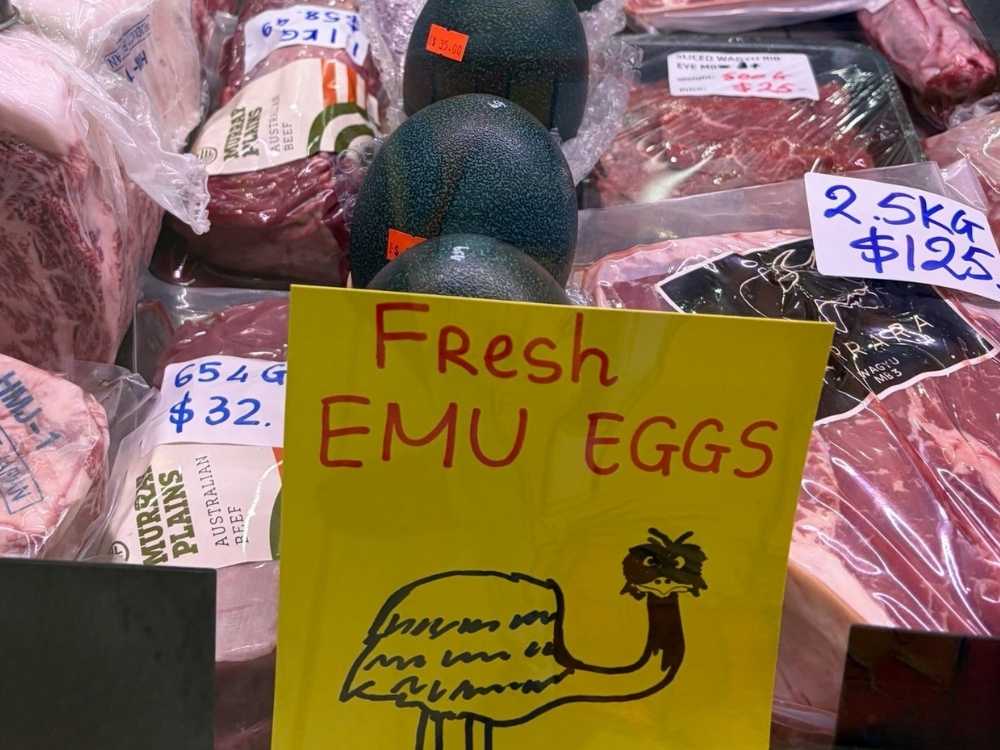
Recently, a Chatswood grocer sparked significant online interest by selling fresh emu eggs. After that story gained attention on various media outlets, ITC was sent a photo showing fresh emu eggs advertised for sale closer to home in Lane Cove.
Several members of the community contacted us asking whether fresh emu eggs could legally be sold directly to customers, particularly after the widely reported Chatswood case. It has taken several weeks and correspondence with two NSW government departments to clarify the regulations.
At a Glance
- Emu eggs were advertised for sale at a Lane Cove butcher, following a similar case at Chatswood.
- The NSW Biodiversity and Heritage Regulator is investigating the alleged Chatswood sale after a referral from Willoughby City Council.
- Licensed emu farmers can supply eggs to retail food businesses such as cafés and restaurants, but whole eggs generally cannot be sold direct to consumers to take home.
- ITC did not lodge a complaint about the Lane Cove business and is not alleging deliberate wrongdoing by any local business.
The cover photo, supplied by a reader, shows several large, dark green eggs in a local butcher’s display cabinet with a sign reading “Fresh Emu Eggs”.
Another reader told ITC the eggs were still being advertised for sale during the first week of July. When we visited the shop before publication, the eggs were no longer on display.
Before publishing, ITC contacted the Lane Cove business on several occasions to explain the information we had received from NSW government agencies, seek clarification and offer the business an opportunity to comment. We did not receive a response.
The Chatswood Emu Egg Story
The Lane Cove sighting followed a news.com.au report about fresh emu eggs being sold by a retailer at Chatswood Chase.
The Chatswood story gained attention after a social media post questioning whether the sale of the eggs was legal was widely shared online.
According to news.com.au, state authorities moved to stop the sale after the outlet brought the matter to their attention, with questions raised about biosecurity and commercial food safety laws.
News.com.au reported that NSW Minister for Agriculture Tara Moriarty said:
“If anyone is illegally selling emu eggs, they should face the full force of the law.”
The report also said the Minister had urged Willoughby City Council to investigate.
There was no suggestion in the news.com.au report that the Chatswood retailer knew the sale of the eggs was unlawful.
Since that time, a spokesperson for the NSW Department of Climate Change, Energy, the Environment and Water (DCCEEW) has confirmed to ITC that the NSW Biodiversity and Heritage Regulator (BHR) is investigating an alleged sale of emu eggs in the Willoughby local government area after receiving a report from Willoughby City Council.
ITC was told that a preliminary investigation was underway to determine the next steps.
The Sale of Fresh Emu Eggs Was Once Prohibited
Until several years ago, the sale of emu eggs for human consumption was prohibited under the conditions applying to emu farming licences.
A spokesperson for the NSW Food Authority told ITC:
“Guidelines have been created in cooperation with the NSW Department of Climate Change, Energy, the Environment and Water (DCCEEW) to support NSW emu farmers to sell eggs for human consumption.
Prior to these guidelines, the licences granted under the NSW Biodiversity Conservation Act 2016 prohibited the sale of emu eggs for human consumption.”
The NSW Food Authority guidelines aim to provide for the safe and controlled sale of emu eggs that may otherwise go to waste, while also providing an additional source of revenue for licensed farmers.
Emu Eggs Can Now Be Supplied to Hospitality Businesses
Licensed emu farmers can sell emu eggs in limited circumstances.
A spokesperson for the NSW Food Authority told ITC:
“The requirements under the Food Standards Code are in addition to those conditions on emu farmer licences granted under the Biodiversity Conservation Act 2016, where emu eggs may only be bought or sold from or to people with a New South Wales or interstate licence to possess and/or trade emus or emu eggs, unless sold in accordance with the NSW Food Authority guidelines, which allows for the sale of emu eggs to retail food businesses only.
The NSW Biodiversity Conservation Act prevents the sale of emu eggs to consumers unless a consumer also has a biodiversity conservation licence.”
But what does “retail food business” mean in this context?
The guidelines state:
“Whole unprocessed emu eggs must not be sold to customers as whole eggs to take away and cook at home. Emu eggs are only to be sold to retail food businesses such as cafés, restaurants, takeaways and caterers.
Emu eggs are not to be sold to a distributor or other intermediary for on-sale to consumers or other retail food businesses.”
So, in a nutshell (or an emu egg, if you like), the regulations allow licensed emu farmers to supply eggs directly to food businesses such as cafés, restaurants, takeaways and caterers that will prepare them for customers.
Whole, unprocessed emu eggs cannot ordinarily be sold directly to members of the public to take home and cook unless the customer holds the relevant biodiversity conservation licence.
This may be where some of the confusion arises. A retailer may assume that if the eggs were supplied by another business, they can legally be sold directly to customers.
The fact that fresh emu eggs were reportedly available at more than one retailer suggests there may be broader confusion about how the regulations apply. ITC cannot say where the eggs originated or whether anyone in the supply chain misunderstood the rules.
Traceability and Labelling
The NSW Food Authority guidelines also set out requirements relating to traceability, egg marking, storage and handling.
The Australia New Zealand Food Standards Code requires eggs, including chicken, quail and emu eggs, to be free from cracks and visible dirt before sale.
Eggs must also be appropriately marked or labelled to support traceability.
Businesses supplying emu eggs must maintain a system that allows the eggs to be traced back to the farm and must keep written records of eggs distributed for 12 months.
The guidelines also state that eggs must be marked with a unique identifier, collection date and best-before date before sale and distribution.
Each batch must include relevant information relating to shelf life, lot identification, warnings, advisory statements and storage and handling instructions.
Who Investigates?
Importantly, ITC did not make a complaint about the Lane Cove business to any regulator and did not request or trigger enforcement action.
ITC contacted the relevant NSW government departments to clarify the regulations after receiving questions from members of the community.
Food regulation in NSW can involve both the NSW Food Authority and local councils.
The NSW Food Authority says it shares responsibility with local councils for regulating retail food businesses under the Food Regulation Partnership.
The primary role of councils under that partnership is to inspect retail food businesses and investigate food safety complaints.
However, the NSW Food Authority’s complaints guidance also lists butchers, food allergens, multi-household food poisoning and other food safety and labelling concerns as matters that may be referred to the Food Authority.
A spokesperson for the NSW Food Authority said:
“If there are specific concerns about the sale of emu eggs, a complaint can be lodged with the NSW Food Authority in the first instance.
Depending on the circumstances, the matter may be investigated by the NSW Food Authority, NSW DCCEEW or a local council.”
No Suggestion of Deliberate Wrongdoing
ITC is not suggesting that the Lane Cove business knowingly breached food safety or wildlife licensing rules.
This appears to be a niche and evolving area of regulation where the difference between lawful supply to a hospitality business and direct sale to consumers may not be widely understood.
In the Cove delivers independent Lane Cove news every day, 100% free, with no paywall. Your support helps ensure Lane Cove continues to have a strong, independent voice.
Support In the Cove:
☕ Shout ITC a Coffee
or
❤️ Contribute Any Amount
or
📣 Advertise with Us