

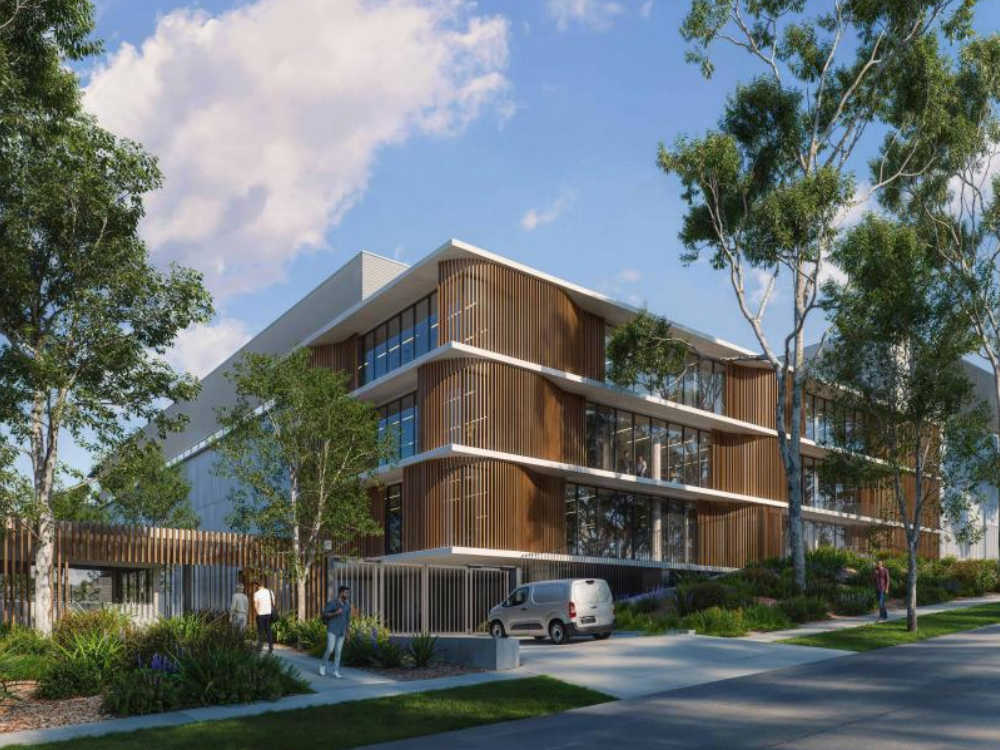
Goodman has lodged a development application for a 90W Data Centre 12 Mars Road, Lane Cove (called Project Mars).
As a first step, an organisation wishing to construct a data centre must request a Secretary’s environmental assessment requirements (SEARs).
SEARs identify what information needs to be included in an environmental impact statement (EIS). Goodman lodged their request for a SEARs in March 2025.
Now, a little over a year later, they have taken the next step and lodged their Environmental Impact Statement (EIS).
You can view the EIS here.
This site is different to the other data centre in Lane Cove West Business Park due to its proximity to residential areas. It is on the very edge of the industrial area.
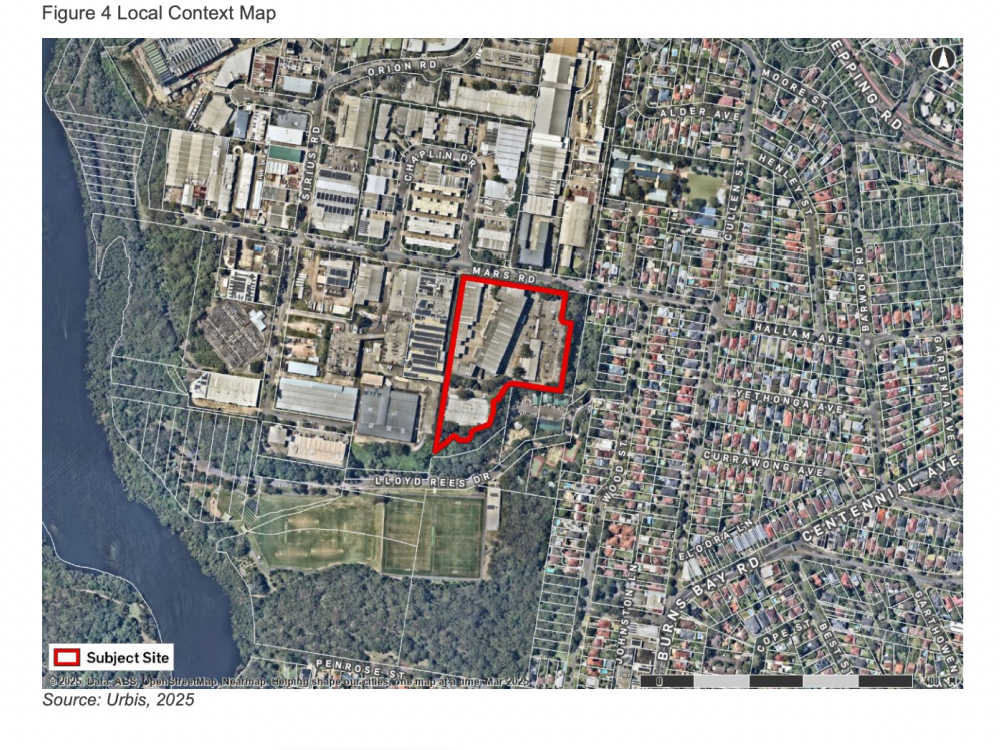
Where is Project Mars located?
The site is located in the Lane Cove West Business Park and is bounded by:
North: Mars Road. Further to the north is industrial development.
South: A landscape buffer. Overlooking the Lane Cove Council Depot, for storage of Council vehicles, and the Blackman Park Grounds. Land to the south zoned RE 1 – Public Recreation.
East: A landscape setback of approximately 50m, followed by low density residential development. Land to the east zoned R2 – Low Density Residential.
West: To the west of the site is existing industrial development
The closest residential properties are located 50m to the east of the site. Lane Cove West Public School is located approximately 160m to the north east of the site.
Key Features
The EIS describes the key features of the construction and operation of the Project Mars Data Centre as follows:
Construction, fit-out and operation of a three-storey data centre building with a total gross floor area of approximately 21,832m2 comprising:
- 24 parking spaces
- 2 loading dock spaces
- 2 levels of technical data hall floor space
- 3 levels of office and amenities building
The following will also be on-site:
- diesel storage tanks
- water tanks
- an electrical substation
The building height will be 28.3 m.
The site is zoned E4 General Industrial, which permits ‘data storage’ use, and includes as its first objective ‘To provide a range of industrial, warehouse, logistics and related land uses.”
The proposal will provide 200 full-time equivalent construction jobs, but only 26 jobs once the data centre is constructed. Goodman is retrofitting a current light industrial site.
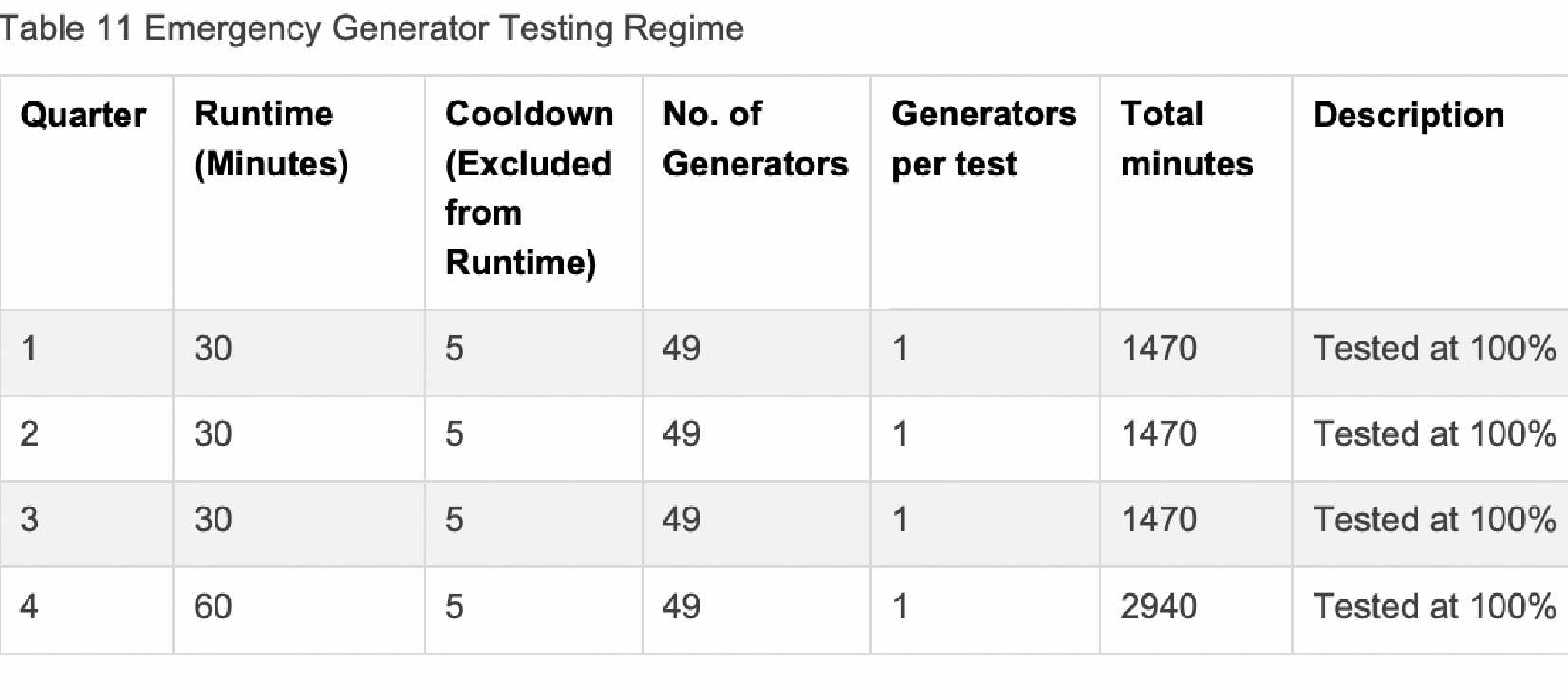
In the final configuration, the proposed back-up power system for the data centre would comprise 49 low-voltage diesel generators (44 x 2.8MW / 3.5MVA, 4 x 2.2MW / 2.75MVA and 1 x 600 KW / 750kVA generators.
Water Usage
Data Centres are heavy users of drinking water. This data centre’s estimated annual on-site water use for the new data centre’s operation is 510,009 m3.
Power Usage
A target average annual Power Usage Effectiveness (PUE) of 1.35 (using ASHRAE Recommended conditions) is set.
Noise
The EIS notes that “during operation, the proposed development will comply with established noise criteria.” But do the current noise regulations account for the constant humming emitted by Data Centres?
There’s one current, one approved, and this proposed hyperscale data centre, all within 600 metres of each other in Lane Cove West Business Park. Airtrunk’s SYD2 on 1 Sirius Road, the soon-to-be-built SYD1 on Apollo Place and Project Mars.
The EIS notes:
“Where operational noise impacts from the development are predicted to exceed the relevant noise criteria, feasible and reasonable operational noise mitigation and management measures should be considered, with the aim of reducing noise emissions to the relevant criteria.”
Information sent to locals after a community information session by Goodman’s consultants stated that the noise during the day “Is noticeable but generally not disruptive for most people.” Nighttime was compared to a library, with sound relatively low and unlikely (ITC emphasis) to disturb most residents.”
In the United States, data centre clusters have formed in several states, such as Virginia, and some local counties, such as Fairfax, have tackled noise issues head-on. Under local regulations, data centre buildings must be at least 200 feet from residential areas or properties. Equipment such as back-up generators must be 300 feet from residential property or separated from the lot line of a residential district or residential property by the data centre building.
Air Quality
Data Centres had diesel generators for their power back ups. Their testing schedule is below:
The report notes there could be a cumulative air quality impact:
“There is a potential for cumulative impacts between the Airtrunk Data Centre and the Project, especially in the emergency scenario. This scenario will eventuate in case there is a grid outage in the area, which may impact the Airtrunk Data Centre and the Project at the same time.”
After Construction
Lane Cove Residents know that once a data centre is built, residents can still be impacted.
In the Cove published a series of articles on cabling companies that have been digging up verges and footpaths in the Lane Cove Council area to provide cabling to customers at the Airtrunk facility. Airtrunk’s customers and not Airtrunk contracted the cabling companies. You can read more here.
You may have also recently seen Interflow (who are Sydney Water’s contractors). They are undertaking significant work installing pipes to provide more water to the Airtrunk facility. This work has been going on for over a year.
You Can Submit Your Feedback on the Proposal
NSW Planning is now asking for feedback on the Data Centre. You can make a submission here. All submissions must be made online. Submissions close on 28 April 2026.
Community Concern Can Impact a Data Centre Proposal
In 2021, Microsoft proposed a six-storey, $141 million data centre at 706 Mowbray Road, Lane Cove North (background here).
Residents were concerned about its proximity to residential areas and Willoughby City Council was concerned about a fire risk.
In February 2023, they announced on the project’s website that they would not proceed. However, they did not provide any reasons or information about what would happen at the Lane Cove North Site (as tenants had vacated the building). An article in Data Centre Dynamics noted the following:
“Evans and Partner technology analyst Paul Mason recently said in a note that Australian players such as NextDC have historically been better than Microsoft at getting council approval, thanks to having more local knowledge on how to handle councils and the lead times associated with procuring utilities.” Read the full article here.
The proposed data centres in North Ryde and Lane Cove represent both opportunity and challenge for Sydney’s growing digital ecosystem. While they support critical infrastructure needed for our increasingly digital world, their proximity to residential areas raises legitimate concerns about noise, energy consumption, health impacts, and environmental effects.
Help ITC to Keep Providing Free Local News in 2026


