

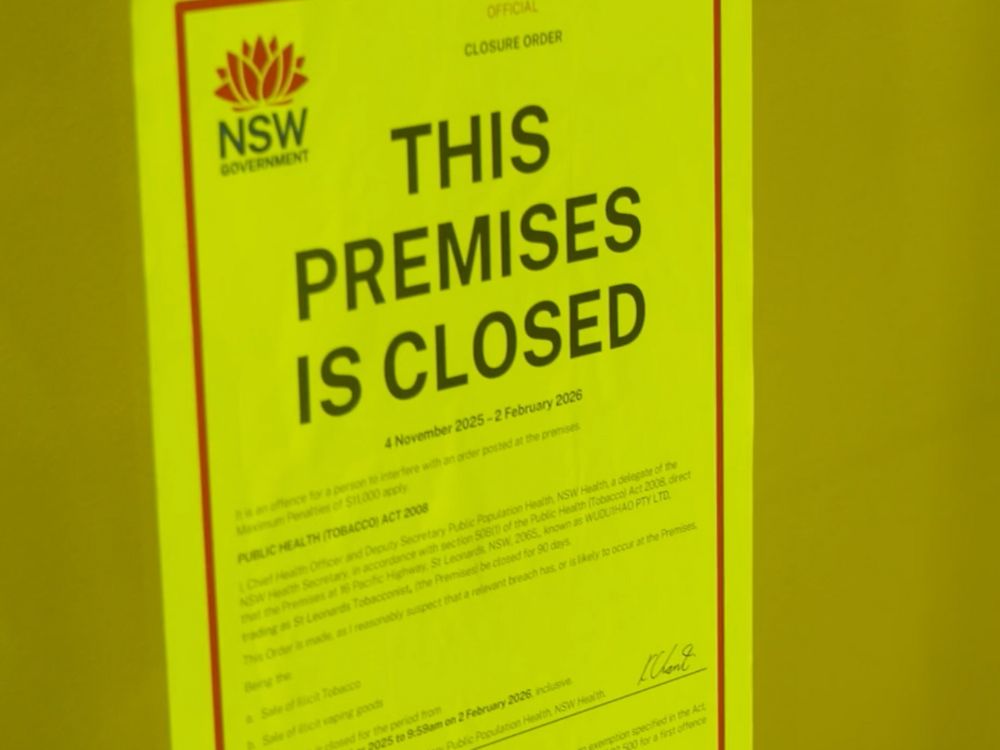
The NSW Government’s crackdown on illicit tobacco and illegal vaping has ramped up, with two stores in St Leonards being shut down for 90 days under new laws. The raids were carried out by the NSW Health Inspectors and supported by police.
During the raid, four tobacco stores were visited, with two closures and two inspections.
As a result of these visits, NSW Health found and seized 3860 illicit cigarettes and 224 illegal vapes. NSW Health may take further enforcement action, which could result in the operators being prosecuted.
NSW Minister for Health, Ryan Park, said: “I can confirm that today we have begun raiding and temporarily shutting down a number of shopfronts suspected of not complying with our tough new tobacco and vaping laws.
“To be sure, this will take some time as we ramp up our closure activities, but this is just the beginning. More will follow in the coming days, weeks and months.
“If you’re doing the wrong thing, sooner or later we will come for you.”
Power To Close Down Stores
The power to close stores came into effect on 3 November 2025.
The new laws allow:
- NSW Health to issue a short-term (90 days) closure; or
- A Local court, on application by the NSW Health Secretary, may order a long-term closure order (up to 12 months).
After a closure order has been issued, it is an offence to sell any products from the closed premises or access the premises (unless an exemption has been issued in relation to access).
In addition to the closure powers, new penalties were introduced on 3 November 2025. A person found to have been selling illicit tobacco can be sentenced to up to 7 years imprisonment or fined up to 1.54 million or both.
NSW Health 2025 Prosecutions
Since 1st January 2025, NSW Health inspectors have inspected around 1,260 retailers and seized more than 11.8 million cigarettes, over 2,000kg of other illicit tobacco products and around 170,000 illegal vaping goods with a combined estimated street value of around $18.9 million.
As a result of these inspections, the NSW Ministry of Health has finalised 17 prosecutions, with the courts imposing a total of $597,200 in fines for e-cigarette and tobacco offences.
There are currently 28 prosecutions, including the District Court appeal, before the Courts.
NSW Tobacco Retailers Licensing Scheme
With three tobacco shops in the Lane Cove Village Area, vaping is something that local parents are concerned about (one tobacco shop closed in 2023).
Lane Cove Council has no control over the types of stores that open in Lane Cove Village (if they fall within the description of commercial premises).
Before 1 July 2025, a retail store starts selling tobacco, non-tobacco smoking products or e-cigarettes, the Public Health (Tobacco) Act 2008 requires businesses to notify NSW Health by applying for a retailer identification number (RIN).
There were no other requirements, unlike other bottle shops, which are subject to a strict licensing and enforcement regime.
On 1 July 2025, NSW’s tobacco licensing scheme commenced.
Tobacco retailers and wholesalers must have a licence to sell tobacco and non-tobacco smoking products in NSW. The retailer identification number (RIN) system is no longer operating.
The tobacco licensing scheme covers tobacco and non-tobacco smoking products. It is illegal for tobacconists, supermarkets, and convenience stores to sell any vaping goods, regardless of their nicotine content.
In NSW, vaping goods can only be purchased from pharmacies for therapeutic use. Pharmacies do not need a tobacco licence to sell vaping products.
In October 2025, four of Australia’s leading experts on Tobacco Control published a research paper addressing the explosion in tobacco retailers across Australia in recent years.
One of the authors was Professor Becky Freeman from the School of Public Health and a member of the Charles Perkins Centre.
Professor Freeman said: “Fewer than 1 in 10 Australians smoke daily, yet cigarettes are sold on just about every street corner – in tobacconists, petrol stations, convenience stores and our local grocery shops.
“Widespread availability is a key part of the tobacco industry’s marketing strategy. Australia’s tobacco market is oversupplied, under-regulated and out of step with community expectations.
“Local communities, particularly parents, are sick of seeing tobacconists pop up everywhere. It’s time to shut the shops and cut the number of stores allowed to profit from this harmful product.”
Co-author Dr Emily Stone, Respiratory Physician at St Vincents Healthcare, said that Australians should remember that all tobacco, regardless of whether it is illicit or legal, is lethal.
Why Are Illegal Tobacco Sales Booming?
In June 2025, NSW Premier Chris Minns called on the federal government to investigate lowering the tobacco excise, which increases the price of legal tobacco. Premier Minns was of the view that the higher prices may be contributing to the increase in organised crime.
In September 2025, Federal Treasurer Jim Chalmers said removing the excise and making cigarettes cheaper would not solve the booming trade in illegal tobacco.
Video of the Two St Leonards Raids
If You Buy Us A Coffee, it is, in fact, helping to pay the ITC Team
We want to clarify that, yes, the ITC team does support local businesses by drinking coffee, but there is a limit to the number of cups you can drink in a day.
We started the Buy Us A Coffee Campaign as a way to keep local news free and to grow our team. Our team is now comprised of three local mums who work part-time to bring you all the up-to-date news, traffic alerts, incidents, and events. We also now have Walkley Award Nominee Jack Kelly writing articles for us, as well as founder Jacky Barker. We truly appreciate any help you can provide, whether large or small.
How local journalism keeps communities engaged
Local newsrooms play a vital role in keeping communities informed and engaged with the decisions that affect them. Without dedicated coverage of local government, infrastructure, and policy changes, many residents are left uninformed about issues that significantly impact their daily lives. Independent newsrooms help bridge this gap, providing a trusted source of information and giving people a platform to voice concerns. Strong local reporting doesn’t just inform, it fosters public participation and strengthens civic engagement. – extract from the Local and Independent News Association Website