

Last year Lane Cove Council signalled that they may have to seek approval to increase rates to sustain the services they are currently offering. The Lane Cove Council has issued its budget papers for the 2026/2027 financial year and the rate rise will be in line with the rate cap – 4.7%. The Budget Papers will be discussed at the April Lane Cove Council Meeting.
However the Long Term Financial Plan which forms part of the Budget Papers forecasts that a significant rate rise is on its way.
Can a NSW Council Levy Rates At Their Own Discretion?
NSW councils rate increases are capped by a rate cap determined by the Independent Pricing and Regulatory Tribunal (IPART). However a council can apply to IPART for a special rate variation (SRV) to increase rates above the rate cap.
In the last two years a number of NSW councils submitted a request to the Independent Pricing and Regulatory Tribunal (IPART) including four metro based councils.
IPART assessed the following special rates variation requests:
| 2025/2026 Council |
Outcome | Notes |
| North Sydney | Not approved | Could only increase by rate peg (4%) |
| Northern Beaches | Partially approved | 12.1% then 11.7% increases approved (lower than request) |
| 2024/2025 Council |
Outcome | Notes |
| Randwick | Approved (full) | Single-year increase approved (11.7%) |
| Willoughby | Approved (full) | 15% increase approved |
IPART is in the process of evaluating special variation applications from ten NSW councils for the 2026/2027 financial year. Additionally, Glen Innes Severn Council and North Sydney Council have submitted requests to raise the minimum rate. The applications are as follows:
- Ballina Shire Council
- Blacktown City Council
- Central Coast Council
- Cessnock City Council
- Glen Innes Severn Council
- Hawkesbury City Council
- Ku-ring-gai Council
- Muswellbrook Shire Council
- North Sydney Council
- Uralla Shire Council
SRV requested by metro based councils:
Blacktown City Council – 16.64 per cent in 2026, followed by two years of 8.53 per cent increases.
Ku-ring- gai Council – 24.6 per cent rise
Hawkesbury City Council – 39.4 per cent over four years
North Sydney Council – 52.66 per cent over three years
What Does the Long Term Financial Plan Forecast?
The Long-Term Financial Plan (LTFP) is Council’s 10-year financial forecast. This year’s LTFP includes three scenarios:
Scenario 1 — status quo: continuing current services plus a few modest priorities (compliance staff, fire safety, after-hours call service). Result: operating deficits every year, and asset renewal collapsing to 60% of depreciation from 2027/28. Council’s own verdict: “not sustainable into the future”.
Scenario 2 — internal savings: adds about $1 million of unspecified savings or new income over two years. Bottom line improves a little, but asset renewal stays at 60% of depreciation — still not sustainable.
Scenario 3 — fund the gap: adds the full $7 million a year of infrastructure renewal funding that Council’s Strategic Asset Management Plan says is needed to lift asset health from 64% to 71%. The only scenario Council labels as financially sustainable.
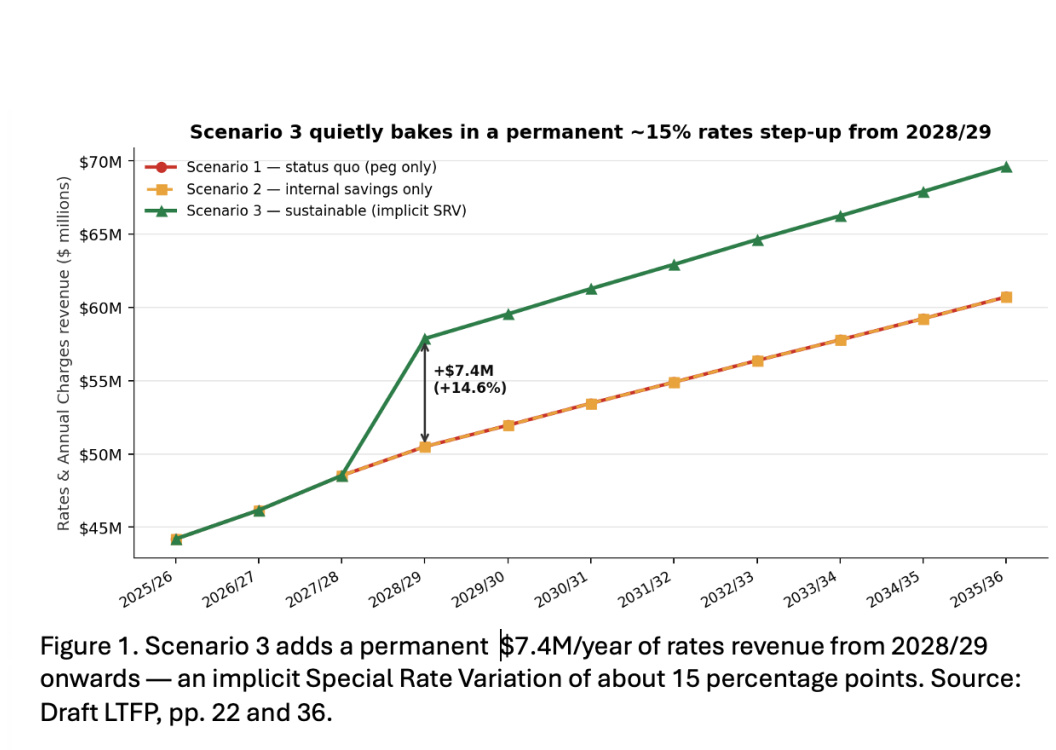
Buried in the Scenario 3 income statement (p. 36) is a significant detail.
In 2028/29, Scenario 3’s Rates and Annual Charges jumps from $48.5 million to $57.9 million. This is a single-year increase of 19.3%, compared with just 4.1% in Scenario 1. That means Scenario 3 relies on roughly 15 percentage points of additional rates revenue on top of the 2028/29 rate forecasst.
This kind of one-off step-up that in NSW can only be implemented via a Special Rate Variation approved by IPART. Once in, it stays in: the uplift compounds every year through to 2035/36.
Why the Forecast Rate Rises Look Like They Taper Off
Lane Cove Council has assumed rate increases fall from 4.7% in 2026/27 down to 2.5% by the mid-2030s. That is not IPART forecasting smaller peg rises. IPART sets the peg one year at a time.
The taper is Council’s own assumption that inflation will return to the RBA’s 2–3% target band (the February 2026 Statement on Monetary Policy forecasts CPI back to 2.6% by December 2028). Rate pegs historically track CPI. The forecast rates don’t “go down” they simply track the assumed return to normal inflation.
Scenario 3 is Described as Illustrative
The Long Term Financial Plan notes: “Further Council considerations and community consultation will lead to the development of further scenarios that could include staging the additional funding requirement over multiple years.”
Staging effectively means spreading the 15 percent uplift over several years rather than a single 15 percent rate rise in one year. A SRV application would most likely be made in late 2027 for the 2028/2029 financial year.
Major Projects Behind The Squeeze
Council’s current financial position remains sound with internally restricted cash reserves of $28.7 million and externally restricted reserves of $34.4 million as at 30 June 2025. However operating results have been deteriorating. Lane Cove Council has noted several reasons for this decline, including a decline in parking fines since the ticketless parking infringement notices were prohibited – read more here.
The LTFP attributes the decline to:
- The tail-end of a decade of major capital projects: The Canopy ($80M), Wadanggari Park ($41.4M), St Leonards Library and Car Park ($32.7M), the Sport and Recreation Facility (Galuwa) at $82.5M, the Bob Campbell Master Plan ($6M), Aquatic Centre electrification ($2.3M), and more.
- Rising depreciation as those new assets start to age.
- Cost-shifting from state and federal governments.
- Employee cost increases of 4% in 2026/27 under the Local Government Award.
- The end of several large capital-grant programs that had been funding renewal work.
How Can The Deficit Be Funded Without a Rates Rise?
Council officers flag they are investigating “advertising opportunities across the LGA” and “trial reductions in free parking periods in Council car parks” as possible revenue measures. This sort of change would partly populate Scenario 2’s $1M savings target.
Public Exhibition
The Draft Budget Papers will be discussed by Council at their April 2026 meeting and then will be put on public display for six weeks. Traditionally Lane Cove rate payers do not submit feedback on the budget papers. This is your chance to get involved. ITC will let you know when the budget papers are published on the Lane Cove Council’s Website.
Rates Analysis and Graphs Provided by ITC unpaid contributor Anthony El-Khoury.
Why Local News Matters
In the Cove delivers independent Lane Cove news every day — 100% free, with no paywall.
We write for the community, from within the community.
We are a proud member of LINA — the Local & Independent News Association, which supports small, independent publishers serving their communities with reliable, accountable local journalism.
Local news strengthens community connection, keeps residents informed, spotlights issues that bigger outlets overlook, and holds local decision-makers accountable. When local news disappears, communities lose transparency, trust and shared understanding. Your support helps ensure Lane Cove continues to have a strong, independent voice.