

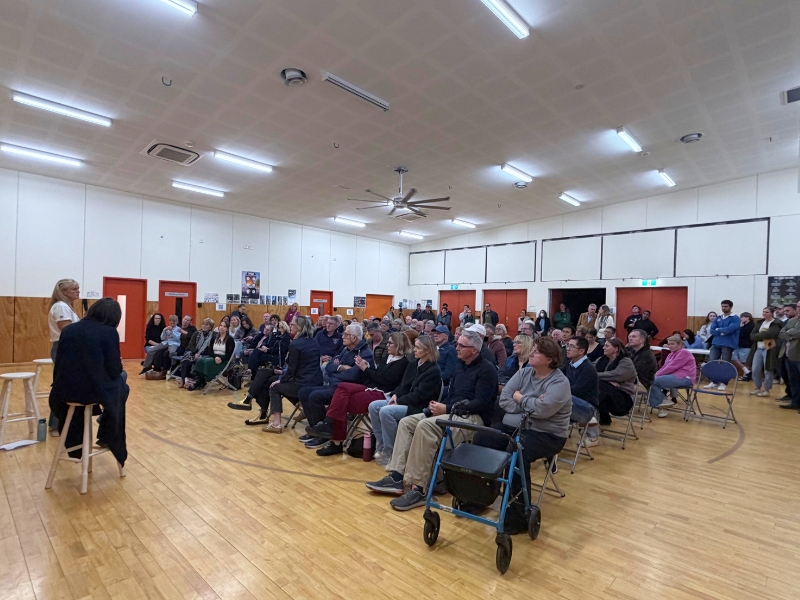
The Scout Hall at Blackman Park was standing room only on Friday 11 September 2026 as Lane Cove West residents gathered to discuss the growing number and scale of data centres proposed for the Lane Cove West Business Park.
In the days since, the community group behind the meeting has escalated its campaign with a shareholder resolution lodged with Goodman’s board, federal senators have come to Lane Cove for the first public hearing of the Senate inquiry into artificial intelligence and data centres, and Goodman has responded to a detailed list of questions from In the Cove.
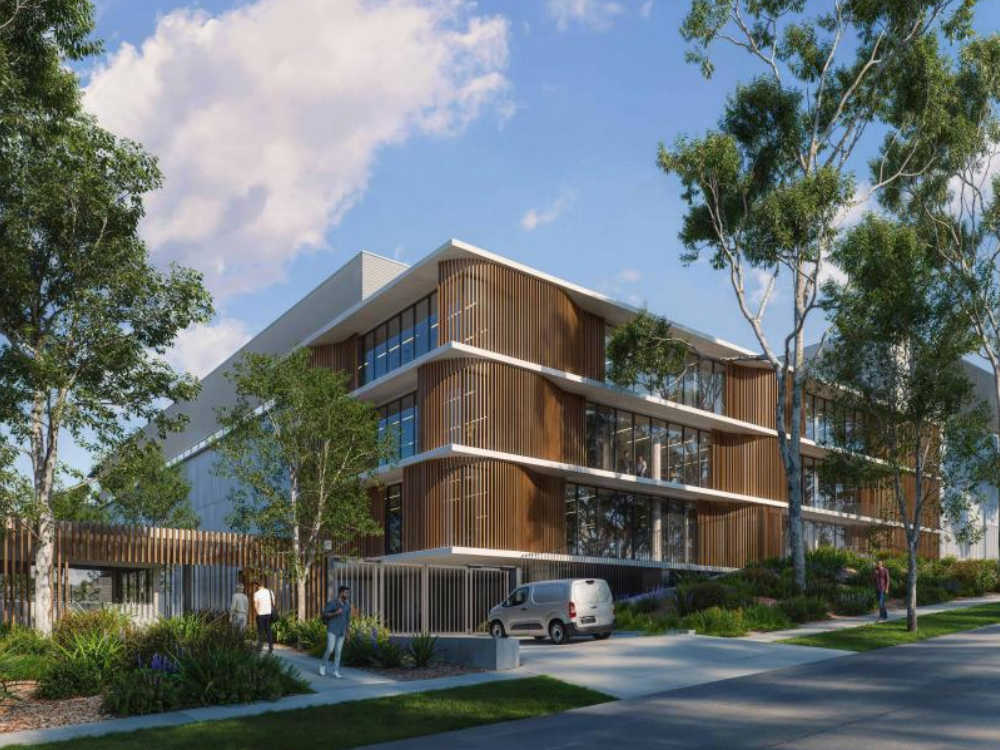
The meeting, organised by the Lane Cove Responsible Planning Group, was called in response to Goodman Group’s Project Mars, a proposed 90 megawatt data centre at 12 Mars Road, Lane Cove West.
Project Mars proposes the construction and 24-hour operation of a large data centre with overall power consumption of approximately 90 megawatts. It is being assessed by the NSW Government as a State Significant Development and is currently at the Response to Submissions stage (where Goodman is required to address concerns raised by government agencies and anyone who objects to the proposal). View the Project Mars application on the NSW Planning Portal.
Goodman was invited to attend Friday night’s meeting to hear directly from residents and answer questions but chose not to attend.
ITC put a detailed list of questions to Goodman before publication. The company’s responses are included throughout this article.
Residents had the following concerns:
- Noise
- Water and sewer infrastructure
- Electricity demand
- Diesel generators and air quality and fire risks
- Bushfire risk
- Building height
- The cumulative effect of having several large data centres concentrated in one area
But the broader issue raised repeatedly during the night was whether Lane Cove West Business Park is an appropriate location for a growing cluster of hyperscale data centres.
This Article at a Glance
- Lane Cove West residents packed the Scout Hall at Blackman Park on Friday 11 September 2026 to discuss the growing cluster of data centres proposed for the Lane Cove West Business Park.
- Goodman Group’s Project Mars proposes a 90 megawatt, 24-hour data centre at 12 Mars Road. It is being assessed as State Significant Development and is at the Response to Submissions stage.
- Goodman was invited to the meeting but did not attend. Member for Lane Cove Anthony Roberts has offered to chair a town hall-style meeting with the company.
- Project Mars attracted 374 public submissions. Only nine supported the proposal.
- Key concerns: noise, cumulative impact of multiple facilities, water and sewer capacity, more than one million litres of diesel storage, building height and proximity to homes.
- Goodman has responded to a detailed list of questions from ITC, confirming a 46 metre minimum setback between the data centre building and the nearest home, and acknowledging that some technical reports contained an incorrect 200 metre setback reference.
- Lane Cove Council has called for data centre State Significant Development applications in the LGA to be temporarily suspended while regulatory issues are worked through.
- Lane Cove Responsible Planning has since lodged a shareholder resolution with the Goodman Group board, believed to be an Australian first for a community group on data centre social licence.
- The first public hearing of the Senate inquiry into artificial intelligence and data centres is being held in Lane Cove this week.
How did Lane Cove West get here?
Concern about data centres in Lane Cove West has grown quickly.
For generations, the business park has operated predominantly as a conventional light industrial and commercial precinct alongside nearby residential neighbourhoods. The businesses located in the Lane Cove West Business Park do not operate 24/7.
That landscape has changed considerably with the arrival of hyperscale data centres.
As ITC reported in April, five data centre facilities are either operating, approved or progressing through the planning system within the Lane Cove West Business Park, including AirTrunk developments, Goodman’s Project Mars and another proposed development at 16 Mars Road.
The development at 16 Mars Road was endorsed by the Investment Delivery Authority (IDA).
In the Cove has been trying to ascertain the developers behind the proposed data centre but has not been able to find any information about the developer, other than they are called Lane Cove Data Centre Alliance.
A NSW government spokesperson told ITC:
“The Investment Delivery Authority (IDA) is guided by a robust governance, operating and probity framework with the protection of commercially sensitive information an important part of its processes.
“Lane Cove DC Alliance is the name the proponent requested be used in relation to the project’s endorsement by the IDA in March 2026.
“Should the proponent choose to progress their proposal, information about the project and the proponent would become publicly available through the planning process.
“It’s important to note that endorsement by the IDA does not guarantee a successful planning outcome.
“Projects need to comply with relevant legislation and policies, both at the State and Commonwealth level, including Foreign Investment Review Board processes, if applicable.”
ITC has lodged a GIPA (in other words an FOI request) to try and find out the developer and how big the proposed data centre will be.
Data Centre Cluster
The concern raised at Friday night’s meeting was therefore not simply about one development application, but what happens when several very large facilities operate within the same precinct.
ITC asked Goodman whether it accepted that the combined impact of the cluster should be assessed together rather than development by development.
A Goodman spokesperson said cumulative impacts were one of the matters considered through the planning assessment process and had been assessed in the noise and air quality impact assessment, with additional information included in the Response to Submissions documentation.
“The Department will assess all relevant environmental, technical and community considerations in determining the application.”
“This has gone out of control”
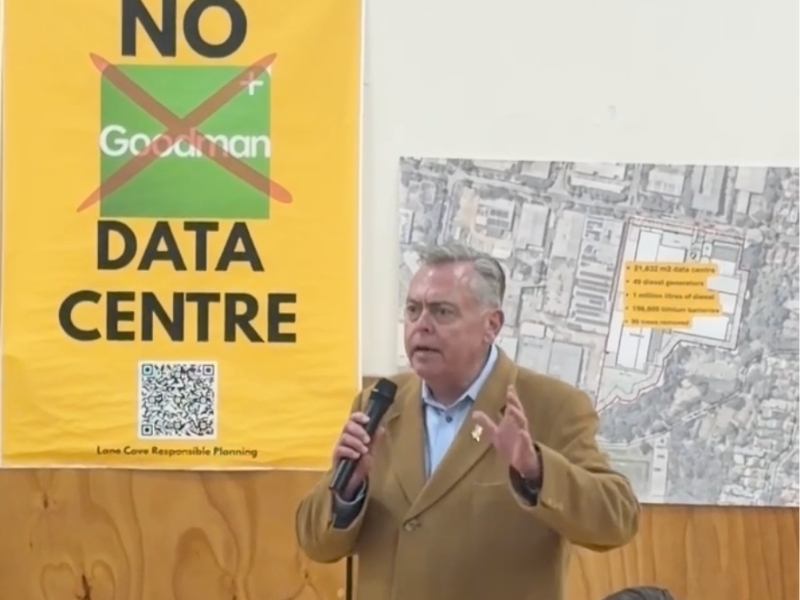
The Hon. Anthony Roberts MP, Member for Lane Cove and a former NSW Planning Minister, attended the meeting and was highly critical of the pace at which data centre development has expanded.
Mr Roberts described the growth of data centres as having “gone out of control” and said government was “quite frankly, asleep at the wheel”.
He said Lane Cove West had operated as a business and light industrial precinct alongside residential areas for generations, but argued the scale and demands of the new generation of hyperscale data centres were very different.
Mr Roberts told residents he was backing Lane Cove Council and the community in seeking greater scrutiny of the developments.
He also referred to the existing AirTrunk data centre beside the Lane Cove River, telling residents they only needed to walk along the foreshore to understand concerns about the constant mechanical noise associated with large facilities.
Mr Roberts is the Member for Lane Cove and currently serves as Shadow Minister for Police and Counter-terrorism and Shadow Minister for Corrections.
Goodman invited to face the community
The meeting heard that Goodman had been invited to meet with residents on several occasions.
Mr Roberts said he understood safety concerns had been raised as one reason for representatives not attending.
He offered to approach Goodman personally and facilitate a town hall-style meeting, saying he would be prepared to chair the meeting and help ensure a respectful discussion.
His view was that residents wanted the opportunity to ask questions directly and receive answers directly from the company.
Organisers responded that they had already invited Goodman to attend on a number of occasions and encouraged Mr Roberts to use his position as the local member to try again.
ITC asked Goodman to confirm why it had not attended, whether it would meet residents directly, and whether it would accept Mr Roberts’ offer to chair a town hall style meeting.
Goodman did not directly answer whether it would accept that offer.
A Goodman spokesperson said the company had undertaken extensive community engagement since announcing the proposal, including community information sessions, webinars, a dedicated project website, email updates, meetings with community representatives and ongoing engagement with elected representatives.
“We believe these channels provide the most productive way to share information, answer questions and ensure all stakeholders have access to the same information.
“We remain committed to constructive and respectful engagement throughout the assessment process and welcome opportunities for ongoing dialogue with the community.”
The spokesperson said Goodman had received hundreds of questions and submissions and was carefully considering the feedback, and that community information session materials, webinar recordings, project information and responses to frequently asked questions were available on the Project Mars website.
Common ground across political lines
One of the notable features of Friday night’s meeting was the breadth of people raising concerns about the growth of the Lane Cove West data centre cluster.
Those involved do not necessarily share the same politics, nor do they necessarily agree on every aspect of the debate.
However, there is common ground around the need to consider the cumulative impact of multiple hyperscale data centres within the same precinct.
Lane Cove Council’s concerns predate the current Project Mars campaign.
In April 2025, Council unanimously adopted a motion raising concerns about the rapid growth of data centres in and near Lane Cove and seeking greater protection for local bushland and infrastructure.
The people involved may have arrived at the issue from different directions, but a question repeated throughout Friday night’s meeting was the same: how many large data centres can one precinct reasonably accommodate, and what are the cumulative consequences for the surrounding community?
What happens if Project Mars is approved?
While organisers made it clear their preferred position was that a development of this scale should not proceed at this location, considerable discussion focused on what safeguards should be sought if Project Mars is ultimately approved.
Noise was one of the major issues.
One speaker pointed to the Viva Energy Gore Bay Terminal at Greenwich as an example of an industrial operation subject to environmental licensing and ongoing noise monitoring.
Residents argued that if Project Mars proceeds, it should be subject to strong independent oversight, continuous noise monitoring at multiple locations and transparent reporting of results.
The discussion also turned to cumulative noise.
Rather than assessing each development in isolation, residents want the potential combined impact of several data centres operating in close proximity to be considered.
ITC asked Goodman whether it would accept conditions of that kind if Project Mars is approved. The company did not commit either way.
“Conditions of approval are a matter for the Department of Planning, Housing and Infrastructure following consideration of expert advice, agency input and community submissions,” a Goodman spokesperson said.
“Goodman will continue to participate constructively in that process.”
Why residents are asking for independent noise monitoring
The call for stronger independent monitoring follows questions previously raised by ITC about how existing data centres are regulated once they begin operating.
In April, an ITC investigation into data centre compliance examined the regulatory arrangements applying to AirTrunk’s existing Lane Cove West facility.
The investigation found the facility did not require an NSW Environment Protection Authority Environment Protection Licence monitored by the EPA. NSW Planning is responsible for monitoring compliance with development consent conditions. NSW Planning does not proactively monitor noise.
A spokesperson for NSW Planning told ITC:
“The Department takes a risk-based approach to setting conditions of consent required for all proposals, including data centres, and specific conditions can vary depending on the project.
“Factors considered include – but are not limited to – the project’s size, location, and projected impacts on amenity and the environment.”
ITC also examined whether required compliance and environmental monitoring documents had been submitted and were publicly available. Until we raised this issue with AirTrunk, they did not have the required documents on their website. This has now been rectified. You can view the documents here.
That experience was part of the background to Friday night’s discussion about whether future data centres should be subject to greater external monitoring and more transparent reporting.
“You can hear the humming before you can see it”
The existing AirTrunk facility was repeatedly used as a real-world example of what residents fear could be multiplied if Lane Cove West develops into a larger data centre precinct.
One speaker encouraged anyone interested in the issue to walk along the Lane Cove River foreshore past the AirTrunk site.
“You can hear the humming before you can see it,” the meeting was told.
The speaker described the scale of the existing facility as something that was difficult to understand from planning drawings alone.
Noise concerns have featured prominently throughout the debate about data centre expansion in Lane Cove. ITC previously examined the potential cumulative noise impacts of a growing cluster in this detailed report on data centre noise.
Water and sewer capacity
Water use and wastewater infrastructure were another major focus of the meeting.
Unlike some of the broader concerns raised by residents, questions about servicing capacity have also been raised directly through the formal planning process.
As ITC reported in May, Sydney Water asked the Department of Planning to defer its assessment of Project Mars until further servicing investigations were undertaken.
Sydney Water advised that the site sits within the Chatswood Water Supply Zone and raised concerns about the capacity of existing infrastructure to service the proposed development.
According to Goodman’s Environmental Impact Statement, Project Mars is estimated to consume approximately 1,405 kilolitres of potable water and generate approximately 468 kilolitres of wastewater each day.
Sydney Water also said demand needed to be considered across the wider growth area rather than looking at Project Mars in isolation.
This is particularly relevant as additional data centres are proposed in the precinct.
ITC has previously examined the broader pressure data centre expansion could place on Sydney Water infrastructure in Data Centre Cluster Boom: Sydney Water Infrastructure Under Pressure as Data Centre Approvals Surge.
At Friday night’s meeting, residents also questioned what chemicals may be used within data centre cooling systems, how wastewater is managed and what monitoring should be required if Project Mars proceeds.
Those questions were raised by speakers at the meeting and should be distinguished from Sydney Water’s formal advice about infrastructure capacity.
ITC asked Goodman to respond to Sydney Water’s concerns and to say what chemicals would be used in the cooling system and how the wastewater would be managed. Goodman did not identify any chemicals.
“We recognise the importance of ensuring infrastructure can support projects of this scale,” a Goodman spokesperson said.
“These matters are being assessed through the planning process in consultation with relevant agencies, including Sydney Water, and will be addressed through the Response to Submissions.”
Height and scale
Residents also questioned why the proposed buildings should be permitted to significantly exceed the scale of the industrial buildings already on the site.
The Project Mars proposal would replace existing industrial buildings with a much larger purpose-built data centre development operating around the clock.
Public submissions lodged against the project have raised concerns about proposed building height, bulk and the extent of mechanical plant required for 24-hour operation.
Speakers at Friday’s meeting argued that if a data centre were permitted at the site, it should at minimum be designed within existing planning controls rather than relying on significant variations.
One organiser said residents should be seeking conditions stringent enough to properly address the impacts identified through the assessment process.
Asked whether Goodman was prepared to design within the existing planning controls rather than seeking variations, a Goodman spokesperson said the proposal was being assessed through the State Significant Development process, which considers the project’s design, scale and planning merits.
“These matters will ultimately be determined by the Department as part of its assessment.”
Diesel generators, air pollution and fire risk
Backup power was another recurring theme.
Large data centres use banks of backup generators to maintain operations during interruptions to grid electricity.
Residents referred to the significant volume of diesel proposed to be stored at the Project Mars site and the quantity of batteries required for backup systems.
Planning material and submissions relating to Project Mars have identified more than one million litres of diesel storage and a substantial lithium battery installation as issues requiring consideration.
Residents argued this needed to be assessed in the context of the site’s proximity to bushland, the Lane Cove River and nearby residential areas.
Speakers also questioned emissions from diesel generators.
One resident said the group had asked whether additional filtration could be fitted to reduce nitrogen oxides, known as NOx, and fine particulate pollution.
The meeting heard differing views about the practicality and cost of this technology. Residents argued that, if the project proceeds, available pollution-control measures should form part of the assessment.
ITC asked Goodman what fire and air quality controls were proposed, and whether it had considered additional NOx and particulate filtration on the generators. Goodman did not say whether additional filtration had been considered.
“Fire safety, hazardous materials management and air quality are being assessed as part of the planning process by technical experts and relevant government agencies,” a Goodman spokesperson said.
“These matters will continue to be considered through the Department’s assessment.”
How close are residents?
The distance between the proposed facility and nearby homes also came under scrutiny.
Residents challenged some of the distances referenced in project documentation and argued homes and residential land sit considerably closer to the development site than some figures used within project assessments might suggest.
In response to questions from ITC, Goodman has now set out its position on those distances in detail.
A Goodman spokesperson said the Environmental Impact Statement referred to the nearest residential receivers being located approximately 50 metres from the proposed data centre, and that this description was accurate.
“Detailed site measurements confirm a minimum setback of 46 metres between the data centre building and the nearest residential receiver.”
The spokesperson said the development also included a 10-metre landscaped setback along the eastern boundary, giving a total separation distance of 56 metres between the data centre building and the closest homes.
Goodman also acknowledged that a residential property at 10 Banksia Street sits approximately 17 metres from the north-eastern corner of the site.
The company said that distance related to the electrical substation component of the proposal rather than the data centre building itself, and that this would be clarified in the Response to Submissions documentation.
Goodman further acknowledged that some supporting technical reports contained an incorrect reference to a 200-metre setback within a standard project description.
“This was an administrative inconsistency rather than an error in the underlying assessments and has since been corrected and clarified through the Response to Submissions documentation,” the spokesperson said.
Proximity to residential neighbourhoods has been a recurring issue in public submissions and in the wider debate over data centre planning.
ITC first explored the issue in Should Data Centres Be Located Near Areas Zoned as Residential?
Why Lane Cove West?
A guest speaker with a research background in the data centre sector gave residents an overview of the economics and infrastructure driving the current construction boom.
She explained the difference between co-location facilities, where an operator develops data halls and rents capacity to technology companies, and enterprise facilities developed directly by major technology companies.
AirTrunk was discussed as an example of the co-location model, with hyperscale technology companies among the customers driving demand for increasingly large facilities.
The speaker said large data centres require access to reliable electricity, network connectivity, cooling infrastructure and sufficient land to expand.
Sydney is attractive because of its telecommunications infrastructure and connectivity to global networks, including submarine cable systems.
Lane Cove West also offers established industrial land relatively close to the Sydney CBD.
However, the speaker said the expansion of hyperscale data centres was creating rapidly growing demand for electricity and water.
She cited modelling forecasting significant increases in the proportion of NSW electricity demand associated with data centres over coming decades.
Council seeks stronger regulation
Deputy Mayor Councillor Rochelle Flood told the meeting Lane Cove Council was concerned that a number of major data centre applications could be determined before broader regulatory reforms were introduced.
Cr Flood said Council had written to relevant state and federal representatives and had advocated for stronger regulation of the sector.
Council has also called for State Significant Development applications for data centres within the Lane Cove Local Government Area to be temporarily suspended while broader regulatory and planning issues are considered.
Cr Flood said Council had advocated for clearer responsibility for regulation of the industry, arguing there was currently a gap between the different authorities responsible for planning, environmental and infrastructure issues.
Council’s stated concerns include cumulative impacts, noise, water and electricity demand, generator emissions and impacts on local bushland and infrastructure.
Her concern, shared by many speakers at Friday night’s meeting, was that projects could be approved before those broader issues had been resolved.
A wider NSW debate
The Lane Cove debate is taking place against the backdrop of a broader review of the rapidly expanding industry.
In January, ITC reported on the launch of a NSW parliamentary inquiry into data centres.
The inquiry is considering issues including data centre clustering, cumulative impacts, electricity and water demand, noise, land use conflicts and whether existing planning and regulatory frameworks are adequate for the rapid expansion of the industry.
The Lane Cove Responsible Planning Group has also joined other community organisations around Australia calling for a pause on further approvals while planning and regulatory frameworks are reviewed. ITC reported on that campaign here.
Goodman raises its own data centre noise concerns
Councillor Merri Southwood highlighted another planning case during the meeting.
She referred to a proposed data centre development at Macquarie Park, where Goodman has interests in nearby land earmarked for residential development.
Through that planning process, Goodman raised concerns about the potential noise impact of the proposed data centre on its nearby residential development.
Goodman submitted to NSW Planning that a rival’s data centre noise study needed more rigorous night-time modelling to account for weather conditions that carry sound further. Its own noise report for the Mars Road data centre appears to have the same gap.
Cr Southwood told the meeting the example demonstrated why Lane Cove West residents believed their own concerns about data centre noise should be taken seriously.
ITC asked Goodman how it reconciled those two positions.
“These are separate projects assessed within their own context, site conditions and technical requirements,” a Goodman spokesperson said.
The spokesperson said noise assessments for Project Mars had been prepared by qualified acoustic specialists and were being considered as part of the State Significant Development assessment process.
Goodman said it had also prepared a response to comments raised by Acoustic Dynamics in its peer review of the noise assessment, and that those comments and broader submissions relating to noise would be addressed in the Response to Submissions.
374 submissions
Project Mars attracted 374 submissions during its public exhibition, according to the NSW Planning Portal.
As ITC reported following the exhibition period, only nine submissions supported the proposal.
Lane Cove Responsible Planning Group said the level of participation demonstrated that concern extended beyond a small number of immediate neighbours.
The meeting heard that residents had spent months reading the Environmental Impact Statement, technical reports, government agency advice and other planning material to better understand the potential implications of Project Mars and the wider growth of the precinct.
Lane Cove Responsible Planning Group stressed that their position was not opposition to data centres as a technology.
Their argument was about scale, location and cumulative impact.
As the Lane Cove Responsible Planning Group put it following the meeting:
“This isn’t opposition to data centres. It’s about appropriate planning, appropriate locations and putting communities at the centre of decisions that will affect them for decades.”
A Goodman spokesperson said every submission received was being reviewed and considered as part of the Response to Submissions.
“We appreciate the significant level of community participation in this process and thank everyone who took the time to make a submission,” the spokesperson said.
“The issues raised by residents, community groups, government agencies and other stakeholders will be addressed through that process and made publicly available.”
The spokesperson said community feedback had helped inform Goodman’s review of the proposal and supporting studies, and that the company expects to lodge its Response to Submissions in the coming months.
Shareholder action
Shareholder activism was one of the avenues discussed at Friday night’s meeting, with some residents considering purchasing Goodman shares in order to participate in shareholder resolutions at the company’s annual general meeting. The speaker discussing the proposal made clear they were not providing financial advice and that any decision to purchase shares was an individual financial decision.
That action has now been taken.
Lane Cove Responsible Planning says it has lodged a shareholder resolution with the Goodman Group board, calling for greater transparency about how the company assesses the environmental, planning, community and social licence risks attached to its rapidly growing data centre business.
A shareholder resolution is a formal item put to a company’s Annual General Meeting for discussion and vote.
The group says the action is believed to be an Australian first for a community group in relation to the social licence of a data centre.
Lane Cove Responsible Planning spokesperson Sasha Titchkosky said the resolution was an escalation of the community’s campaign and reflected a broader national problem.
“Companies like Goodman need to do better and communities should not have to fight these developments one project at a time because our planning and regulatory systems have failed to keep pace with the extraordinary speed and scale of the data centre boom,” Ms Titchkosky said.
“Data centres are important infrastructure, but that does not mean they belong everywhere.
“Governments need clear rules about where hyperscale data centres can and cannot be built, how their cumulative impacts are assessed, and how communities are involved before locations effectively become data centre precincts.”
Ms Titchkosky said the Prime Minister had himself acknowledged the industry needed a social licence.
“That social licence cannot simply be assumed because a development is technically permissible under a planning instrument. It has to be earned from the communities expected to live alongside these facilities.”
She said community opposition should not be treated as an afterthought by the industry, describing it as “a material development risk that boards and investors need to understand”.
Group opposes AirTrunk’s proposed 140MW facility
Lane Cove Responsible Planning has also made clear its opposition is not limited to Project Mars.
The group says there should be no further data centre development in the Lane Cove West Business Park at all, including AirTrunk’s proposed new 140 megawatt Mars Road data centre adjoining its existing and approved facilities.
The group says that proposal would sit within metres of the Lane Cove River and Lane Cove National Park, and would further concentrate hyperscale data centres within a relatively small industrial precinct.
“Our community does not support Lane Cove West becoming a hyperscale data centre hub,” Ms Titchkosky said.
Senators in Lane Cove
The shareholder action coincides with the first public hearing of the Senate inquiry into artificial intelligence and data centres, being held at Waterview Community Centre in Lane Cove today, 22 September 2026.
The inquiry is being conducted by the Senate Environment and Communications References Committee, chaired by Greens Senator Sarah Hanson-Young. Further hearings are scheduled for Yarraville in Victoria and Canberra.
Community groups, local councils and AI experts are giving evidence, with the location and cumulative impact of data centres in urban areas a central theme.
What happens next?
Project Mars remains under assessment by the NSW Department of Planning and is currently at the Response to Submissions stage. Goodman told ITC it expects to lodge that response in the coming months.
The NSW planning system, rather than Lane Cove Council, is responsible for determining the State Significant Development application.
For the residents who packed Blackman Park on Friday night, however, the issue now extends beyond one application.
The concern is what happens if Project Mars becomes another piece of a much larger data centre cluster in Lane Cove West.
But Friday night’s meeting demonstrated considerable common ground around one question: before more hyperscale facilities are approved in the same precinct, should their combined impact be assessed as a cluster rather than development by development?
Residents also made it clear they want the companies proposing these developments to engage directly with the communities expected to live alongside them.
Goodman Group responded to a detailed list of questions from In the Cove a few hours before publication. Its responses are now included throughout this article.
Previous ITC Data Centre Coverage
- Lane Cove Community Group Joins National Push to Halt Data Centre Approvals
- Goodman Data Centre Under Pressure After Mass Public Submissions
- Lane Cove Data Centre Compliance
- Two More Data Centres Planned for Lane Cove West Business Park
- Goodman Lodges Mars Road Lane Cove West Data Centre Development Application
- NSW Parliamentary Inquiry Launched into Data Centres Rapid Expansion
- Cluster Boom: Will Data Centre Noise Be Noticeable in Your Lane Cove Neighbourhood?
- Data Centre Cluster Boom: Sydney Water Infrastructure Under Pressure as Data Centre Approvals Surge
- Should Data Centres Be Located Near Areas Zoned as Residential?
- Two New Data Centres Planned for In and Near the Lane Cove Local Government Area
In the Cove is independent and locally owned. If this reporting matters to you, support ITC here.
In the Cove is free to read and always will be. There is no paywall. Your support helps ensure Lane Cove continues to have a strong, independent voice.
Support In the Cove:
☕ Shout ITC a Coffee
or
❤️ Contribute Any Amount
or
📣 Advertise with Us