

By Jack Kelly, In the Cove, with contributions from Jacky Barker
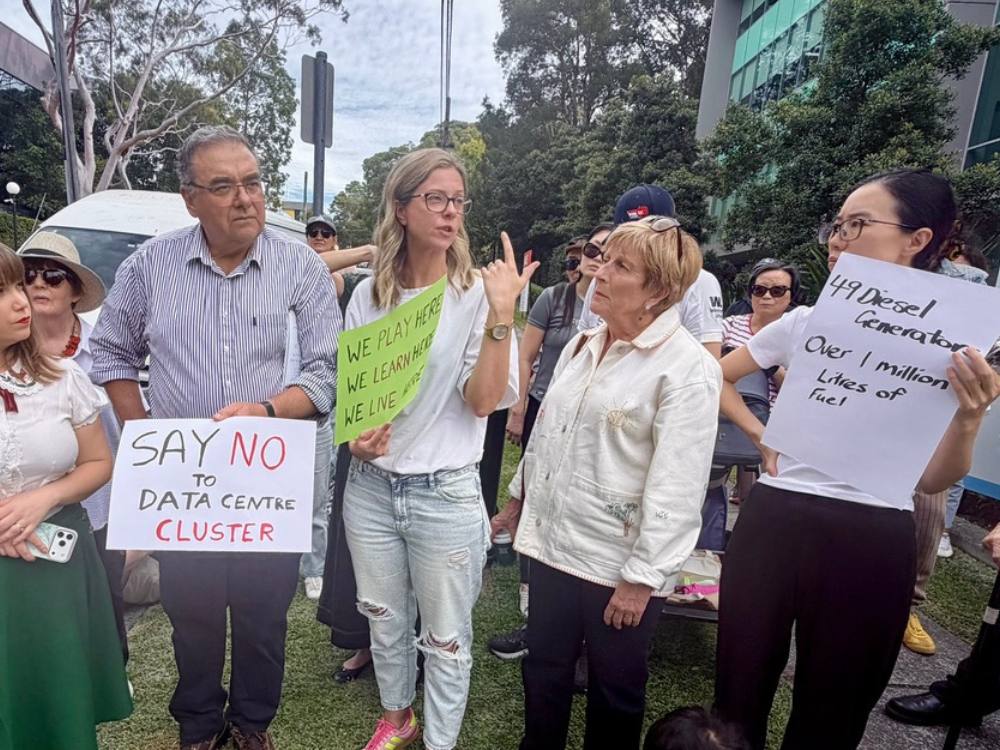
Lane Cove is quickly becoming a favourable location for hyperscale data centres, but with this rapid expansion comes the issue of who is enforcing the planning protocols put in place to protect impacted communities.
NSW Planning is the only regulator with compliance oversight of AirTrunk’s SYD2 data centre’s noise, fuel storage and generator operation. The EPA does not require AirTrunk to hold an Environment Protection Licence for any NSW premises. There is no other watchdog. And the watchdog hasn’t been watching.
Lane Cove business park is rapidly becoming one of NSW’s most concentrated zones for hyperscale data centres. AirTrunk already operates SYD2 at 1 Sirius Road, another recently approved data centre on Apollo Place and is seeking approval for a third facility neighbouring its existing site.
Goodman has also lodged an application for 12 Mars Road and an organisation called Lane Cove DC Alliance has signalled its intention to build a data centre at 16 Mars Road. If all are approved, four hyperscale data centres will operate side by side in the same suburban business park, each running 24 hours a day, seven days a week, drawing enormous quantities of power and water.
The obvious concern is the cluster itself. The less obvious concern, and the more serious one, is who is making sure they comply with the conditions under which they were approved.
Key Points we discuss
- AirTrunk’s SYD2 data centre has not submitted key compliance reports required under its planning approval.
- Some reports, including the Long Term Environmental Management Plan, are now several years overdue.
- NSW Planning is the sole regulator, with no EPA licence required and no other agency overseeing compliance.
- Operational noise has already exceeded predicted levels at nearby residential buildings.
- Fire and Rescue NSW confirmed it has not received required fire safety documentation for the facility.
- Multiple additional hyperscale data centres are proposed within the same Lane Cove West business park.
What the Consent Requires
When AirTrunk’s SYD2 facility received its initial development consent in 2019 (SSD-9741), it came with a set of mandatory reporting obligations designed to ensure the facility’s real-world impact matched what had been approved on paper. These weren’t optional, they were conditions of consent, enforceable under NSW planning law.
The facility is built and brought into operation in phases distinct physical sections of the building commissioned. This staged approach is why the reporting obligations are also staged: the actual environmental impact of a facility can differ significantly from what modelling predicted, and regulators need to know that before the next phase comes online.
Three categories of report were required. Noise Verification Reports were to be submitted to the Planning Secretary within three months of the commencement of operation of each of Phase 2, Phase 3 and Phase 4. A Long Term Environmental Management Plan was required to be submitted prior to operation, following completion of a Site Audit. A Back-up Generator Log was required to be maintained for the life of the development and made available to the Planning Secretary upon request.
None of these have been submitted or published.
The Finding
ITC has uncovered that noise verification reports and a Long Term Environmental Management Plan for AirTrunk’s SYD2 facility have not been submitted to, or published by, NSW Planning. The Department of Planning, Housing and Infrastructure confirmed it has not received these documents. A spokesperson said the Department’s compliance team “proactively monitors projects to ensure they comply with their conditions of approval.”
However, the wording of the consent tells a different story.
The Consolidated Consent states noise verification reports must be submitted to the Planning Secretary within three months of the commencement of operation of Phase 2, Phase 3 and Phase 4. AirTrunk’s own press release confirms Phase 3 commenced operation in August 2024 – on the plain wording of the consent, that deadline has passed by over a year. Phase 2 would have had its own earlier deadline, also missed.
The Long Term Environmental Management Plan was not tied to phases at all. It was required to be submitted prior to operation, following completion of a Site Audit. Operations commenced in March 2021. No LTEMP has been published. The report is five years overdue.
Despite this, AirTrunk maintains that any copies of reports must be requested via Planning NSW; despite having its own consent obligation to publish approved plans, regular environmental performance reports and a monthly complaints register on its website, none of which are currently available there.
Why It Matters – The Noise Findings
The reporting obligations exist precisely because the gap between predicted and actual impact has already proven significant.
During Planning NSW’s assessment for SSD-9741’s third modification, its own report found that Phase 1 alone – just 25 per cent of the full facility – was already operating 5 dB(A) louder than the noise predicted for all four phases combined. The discrepancy was attributed to chiller fan speed loads running at 60 per cent rather than the assumed 35 per cent.
Consequently, operational noise from Phase 1 was found to exceed the night-time noise limit of 43 dB(A) at the nearest residential receivers, the Arise Lane Cove apartment tower at 150 Epping Road, by 11 dB(A). The World Health Organisation recommends community noise levels below 30 dB(A) in bedrooms at night for good-quality sleep. The NSW EPA Noise Policy for Industry recommends a maximum of 55 dB(A) for suburban residential areas during the day.

Although AirTrunk’s data centres are located in a business park where noise restrictions are more lenient than in residential zones, the site closely neighbours homes, cafes, a school and a childcare centre.
Hyperscale data centres run 24 hours a day. Their servers require constant cooling, facilitated by large mechanical chiller systems globally recognised as a source of noise disturbance. The stage-by-stage noise verification reports were designed specifically to allow engineers to verify that noise controls were working and make corrections before the next phase came online. They have not been submitted.
Fire Safety
The missing compliance reports are not the only concern – AirTrunk also misrepresented its fire safety compliance to the regulator.
During the MOD-3 modification process in September 2023, AirTrunk told Planning NSW in its Response to Submissions that a revised Fire Safety Study had been submitted to Fire and Rescue NSW (FRNSW) for the existing SYD2 facility. Nearly two years later, FRNSW formally contradicted that claim in writing.
In a letter dated 11 July 2025 to Jeffrey Peng at NSW Planning, Senior Firefighter Michael Millar of FRNSW’s Fire Safety Liaison Unit wrote: “Contrary to the responses provided for SSD-9741-Mod-3 on pages 3 and 4 of Table 1: Response to Submissions (dated 18 September 2023), FRNSW advises that a revised Fire Safety Study has not been submitted to FRNSW for review for the existing Lane Cove West Data Centre facility and FRNSW has not provided a response that the facility meets FRNSW’s operational requirements.”
This was not the first time FRNSW had raised concerns. Planning’s own MOD-3 Assessment Report, published in June 2024, already recorded that FRNSW had not received the required emergency response plan for SYD2, and that the fire safety study needed to be updated. That gap sat on the public record for over a year before FRNSW escalated it in writing.
In the same July 2025 letter, FRNSW warned that data centres “present special problems of fighting fire and suitable additional provisions are likely to be required,” and recommended that a combined Fire Safety Study be submitted prior to construction of any further facility on Apollo Place.
It is unknown why Planning NSW did not follow up with FRNSW to verify AirTrunk’s 2023 claim before accepting it. What the documents show is that a false statement was made to a regulator, it went unchecked for two years, and was only contradicted when FRNSW raised it again during assessment of AirTrunk’s next facility.
The Cumulative Problem
Lane Cove Council has no power to make decisions on these projects because the facilities surpass the threshold for State Significant Development, that authority rests entirely with the state. Council can only offer concerns, and it has been doing so.
Lane Cove Council has launched a Have Your Say page for Goodman’s lodged proposal at 12 Mars Road, citing the structure’s height far exceeding local restrictions, its potential noise impact given it will sit just over 100 metres from homes, and its proximity to protected bushland. It has also called for an assessment of the cumulative impact of four hyperscale data centres operating side by side.
These are the same concerns the existing consent conditions were designed to manage and those conditions have not been enforced.
Greens NSW MLC Abigail Boyd is hosting a community forum – “Lane Cove as a National Data Centre Hub” – tomorrow night, Wednesday 29 April, 6:30pm to 9pm at The Diddy, Kenneth St & River Rd W, Longueville. RSVP here.
A Structural Gap
The failure here is systemic. NSW Planning is the sole compliance regulator for SYD2. There is no EPA licence, no other agency checking whether the reports have arrived. When the reports don’t come and the regulator doesn’t follow up, nothing happens.
This matters more as the cluster grows. NSW is accelerating data centre development through its new Investment Delivery Authority, which can make recommendations directly to the Planning Minister. Four facilities are proposed or operating in a single Lane Cove business park.
AirTrunk’s SYD2 facility needs to be reviewed by Planning NSW. A stricter and more transparent compliance process needs to be in place before Goodman’s facility – and whatever comes after it – is approved.
As for AirTrunk’s third proposed facility, Planning NSW has said: “The proposed data centre project has not been lodged in the planning system. More information about the project will be available if and when that happens.”
In the Cove’s Data Centre Coverage
- April 2025 – First report on emerging data centre cluster in Lane Cove
- August 2025 – Should data centres be located near residential areas?
- December 2025 – Water infrastructure under pressure as approvals surge
- December 2025 – Will data centre noise be noticeable in your neighbourhood?
- January 2026 – NSW Parliamentary Inquiry launched into rapid expansion
- March 2026 – Lane Cove Council’s submission fails to address noise or air quality
- April 2026 – Goodman lodges Mars Road development application
- April 2026 – Two more data centres planned for Lane Cove West
💛 A note from In the Cove
For nearly 14 years, In the Cove has been here — covering the stories that matter to Lane Cove. We’re a small, local team and most of what we do is free.
From 3 May, we’re joining independent newsrooms across Australia for Our News. Your Voice — a national campaign run by LINA to support community journalism like ours.
Want to support us? Our campaign opens Sunday 3 May — mark it in your calendar. 💛