

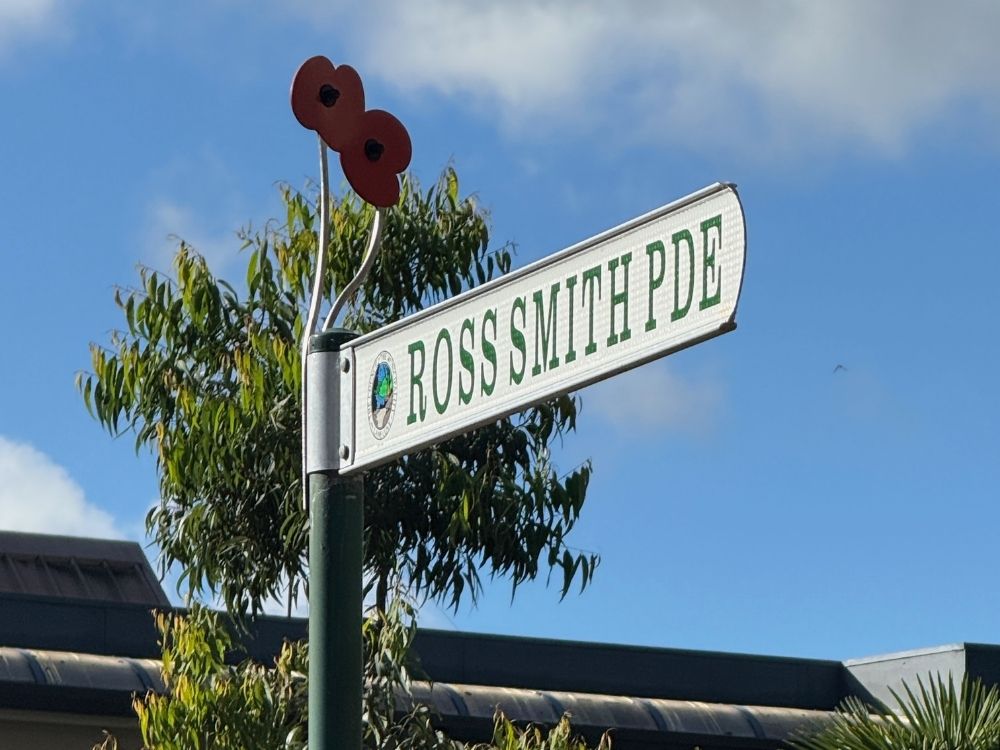
Have you ever noticed the red poppies attached to some street signs around Lane Cove, like the one in our cover photo?
They’re easy to miss — but each one tells a powerful story. These poppies mark streets named after local men who served — and in many cases died — during World War I.
Let’s take a moment to remember the people behind the names we pass every day.
Here are some of the stories behind Lane Cove’s red poppy street signs:
BIRDWOOD AVENUE
Birdwood Avenue honours Lieutenant General Sir William Birdwood, the British officer who commanded the Australian Imperial Force during World War I. Deeply admired by Australian troops, he later toured Australia to great acclaim. Birdwood Avenue was named in his honour around 1920. Birdwood Lane was also named after him.
BURLEY STREET
When war broke out, Lieutenant Leslie James Burley lived with his family on Charles Street in Greenwich. He arrived at Gallipoli just a week after the landings, but was fatally wounded two weeks later, on 19 May 1915, aged just 23. He was buried at sea.
CAMPBELL AVENUE
Campbell Avenue is named after Frederick Campbell, the long-serving headmaster of Longueville Public School. Three of his sons — Rupert, Stewart and Arthur Bede — served in World War I. All three sons returned home safely.
GARLING STREET
Terence and Raymond Garling grew up on Burns Bay Road in Lane Cove. Terence served at Gallipoli and on the Western Front, where he was badly wounded and later died in 1918. His brother Raymond continued to serve but remained in Australia. Raymond resigned after Terence’s death.
GRAHAM STREET
William George Graham and his brother Nichol enlisted together from Lane Cove to serve in the 18th Battalion. William was killed in May 1917 on the Western Front, while Nichol survived the war, resumed his trade as a butcher and later became Mayor of Lane Cove. The street was named in William’s honour in 1918.
HALLAM AVENUE
Private Richard Henry Hallams was just 19 years old when he enlisted in 1916. A young grocer, he was killed by shellfire in France in April 1917. Hallam Avenue, along with Garling, Munro and Gentle Streets, was named to honour him and other local men who lost their lives in war.
HOLDEN STREET
Lieutenant Hugh Cyprian Holden lived with his family in Northwood, at what is now 5 Upper Cliff Road. Serving with the 12th and 7th Light Horse Regiment at Gallipoli, he was killed in action on 23 November 1915. Holden Street was named in his memory.
RICHARDSON STREET
Captain John William Richardson grew up in Lane Cove, attending Longueville Road Public School and serving with the local church. He was deployed with the 34th Battalion in France and was killed in late 1917. Though his body was never found, Christine Road was later renamed in his honour.
MUNRO STREET
Munro Street was named for William Henry Charles Munro, who died of wounds during World War I on 28 May 1918.
William, known as Will, was born in 1892 and initially lived near Figtree Wharf with his parents and six sisters. After a short stint as caretakers at what is now Carisbrook Historic House, the family built a house at Tambourine Bay opposite Riverview College, on land now part of Tambourine Bay Reserve.
At the time of his enlistment, Will worked as a tanner at Ludowici’s, where he had completed a four-year apprenticeship. He was also a local champion cyclist, and family members still hold two of his gold medallions.
Will enlisted on 18 January 1916 and left Sydney on 1 April 1916 for France via the Suez Canal and England, where he joined the 2nd Infantry Battalion, 16th Reinforcements, on the Western Front. He was wounded in action on 22 September 1917 at the Third Battle of Passchendaele and was sent to London to recover from wounds to his face and hand.
Will rejoined his unit in January 1918, but died of further wounds on 28 May 1918. He is buried at Ebblinghem Military Cemetery in France.
William Henry Charles Munro is listed among the 104 names on Lane Cove’s World War I Honour Roll, located at Lane Cove Civic Centre.
ROSENTHAL AVENUE
Rosenthal Avenue is named for Major General Sir Charles Rosenthal, who commanded Australia’s 2nd Division during the war. He was wounded twice at Gallipoli, led his men on the Western Front and later oversaw the return of Australian troops home in 1920. He is remembered in the naming of both Rosenthal Avenue and Rosenthal Lane.
ROSS SMITH PARADE
Ross Smith was Australia’s first great pioneering airman and the most decorated member of the Australian Imperial Force. He was killed in an air crash in 1922. Lane Cove has a history of naming streets after great wartime heroes, even when they did not have a direct connection to the area.
WARDROP STREET
Sergeant William “Bertie” Wardrop of Greenwich was the first soldier from Lane Cove to die at Gallipoli. He was wounded just days after the landings and died aboard a hospital ship on 30 April 1915. Wardrop Street was named in his honour.
Discover Your World War I Australian Soldier
Curious about your own family history?
Lane Cove Library regularly hosts hands-on workshops to help you trace your Australian World War I servicemen and women.
You can learn how to use Trove, archives, genealogy websites and published sources to uncover what your ancestors did during World War I and World War II.
To discover more about these individuals and Lane Cove’s wartime history, visit the Local Studies team at Lane Cove Library — an invaluable resource for anyone wanting to explore our community’s past.
Keep an eye on upcoming events at Lane Cove Library for future sessions.
Support Local News
In the Cove delivers independent Lane Cove news every day — free and accessible to everyone.
If you value local journalism that keeps our community informed, connected and accountable, please consider supporting us.
Support In the Cove here →