

Australia’s birth rate has hit a record low. In 2024, the national fertility rate fell to 1.48 babies per woman. This is the lowest ever recorded and well below the 2.1 replacement rate.
NSW births dropped 7.2% between 2019 and 2023, from 95,133 to 88,297. Children entering kindergarten today come from smaller birth cohorts, and that demographic shift is now showing up in classrooms across Sydney’s lower North Shore.
In 2024, the NSW Productivity Commissioner Peter Achterstraat warned: “If we don’t act, we could become a city with no grandchildren.”
Sydney is losing some 7,000 people aged 30 to 40 every year.
Between 2016 and 2021, twice as many in that age bracket left Sydney as arrived — 70,000 out, just 35,000 in. (That period includes the COVID-19 pandemic years, which likely amplified the trend.)
In The Cove has analysed enrolment data across Lane Cove’s public and non-government schools. The picture is nuanced: most schools are losing students, a couple are holding steady or growing, and the kindergarten pipeline tells us the trend may not be over yet. But Lane Cove is not alone; this is a pattern playing out across the entire lower North Shore.
The Numbers: What’s Happening at Our Local Schools
We sourced enrolment data from ACARA’s MySchool website and NSW Education annual reports for every school in and around the Lane Cove LGA. Here’s what the last decade looks like:
| School | 2014 | 2016 | 2018 | 2020 | 2022 | 2024 | 1 yr | 3 yr | 5 yr |
| Lane Cove PS | 824 | 840 | 881 | 826 | 769 | 734 | +0% | -8% | -15% |
| Lane Cove West PS | 576 | 579 | 589 | 605 | 531 | 483 | -6% | -15% | -21% |
| Greenwich PS* | 357 | 380 | 386 | 359 | 349 | 393 | +7% | +13% | +3% |
| Mowbray PS | 378 | 437 | 595 | 642 | 674 | 700 | +0% | +7% | +10% |
| St Michael’s | 543 | 544 | 534 | 511 | 528 | 520 | -1% | -4% | -0% |
| Chatswood PS | 957 | 1,180 | 1,291 | 1,343 | 1,142 | 1,116 | -1% | -8% | -15% |
Source: ACARA MySchool, NSW SPARO Annual Reports. * Greenwich PS figures are mainstream enrolment only and exclude the support unit.
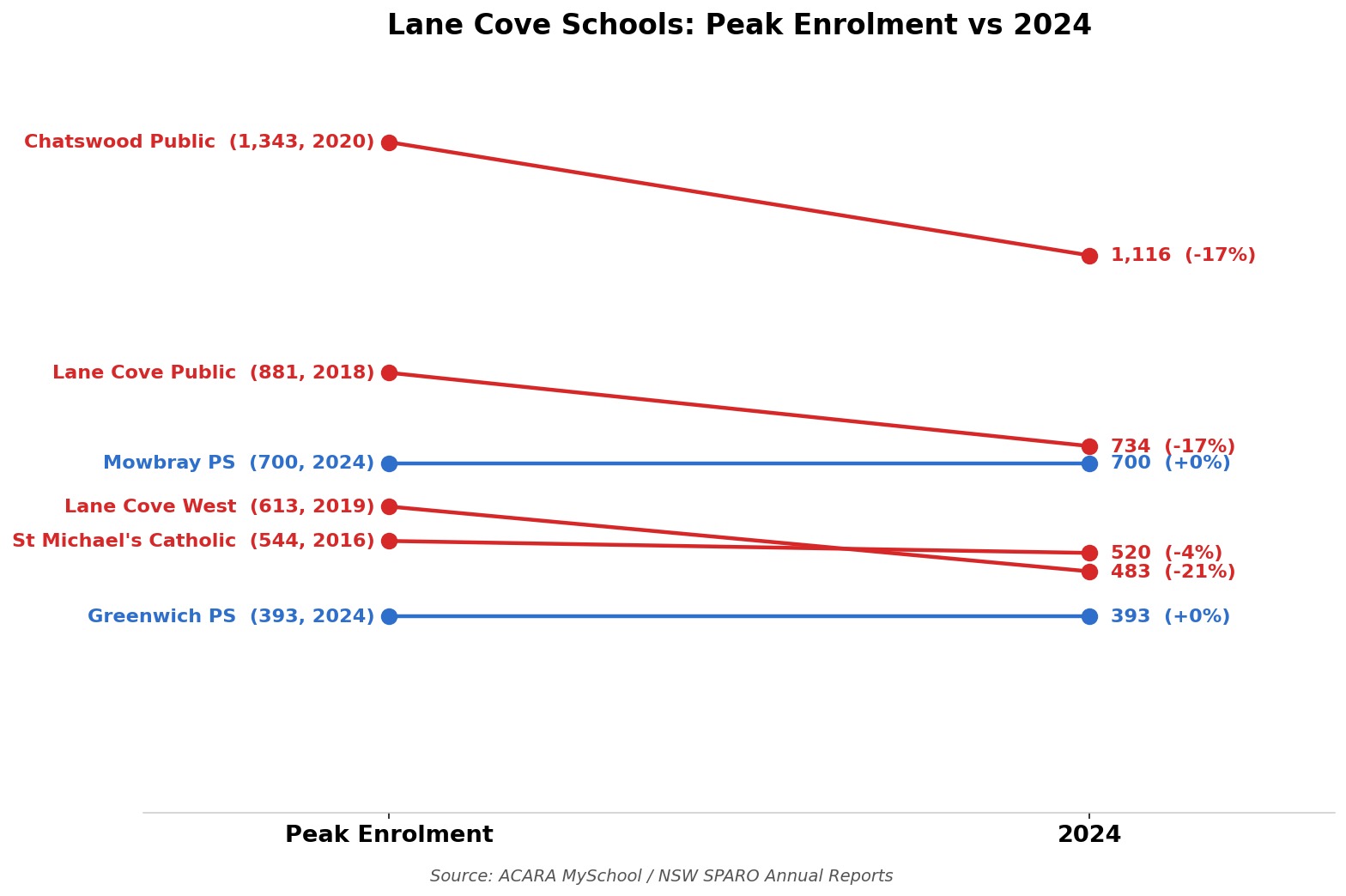
Key Takeaway: Lane Cove Public peaked at 881 students in 2018 and has since fallen to 734 (–17%). Lane Cove West has lost 1 in 5 students since 2019, dropping from 613 to 483. Chatswood Public peaked at 1,343 in 2020 and has fallen to 1,116 (–17%). Mowbray Public is the standout, nearly doubling from 378 to 700.
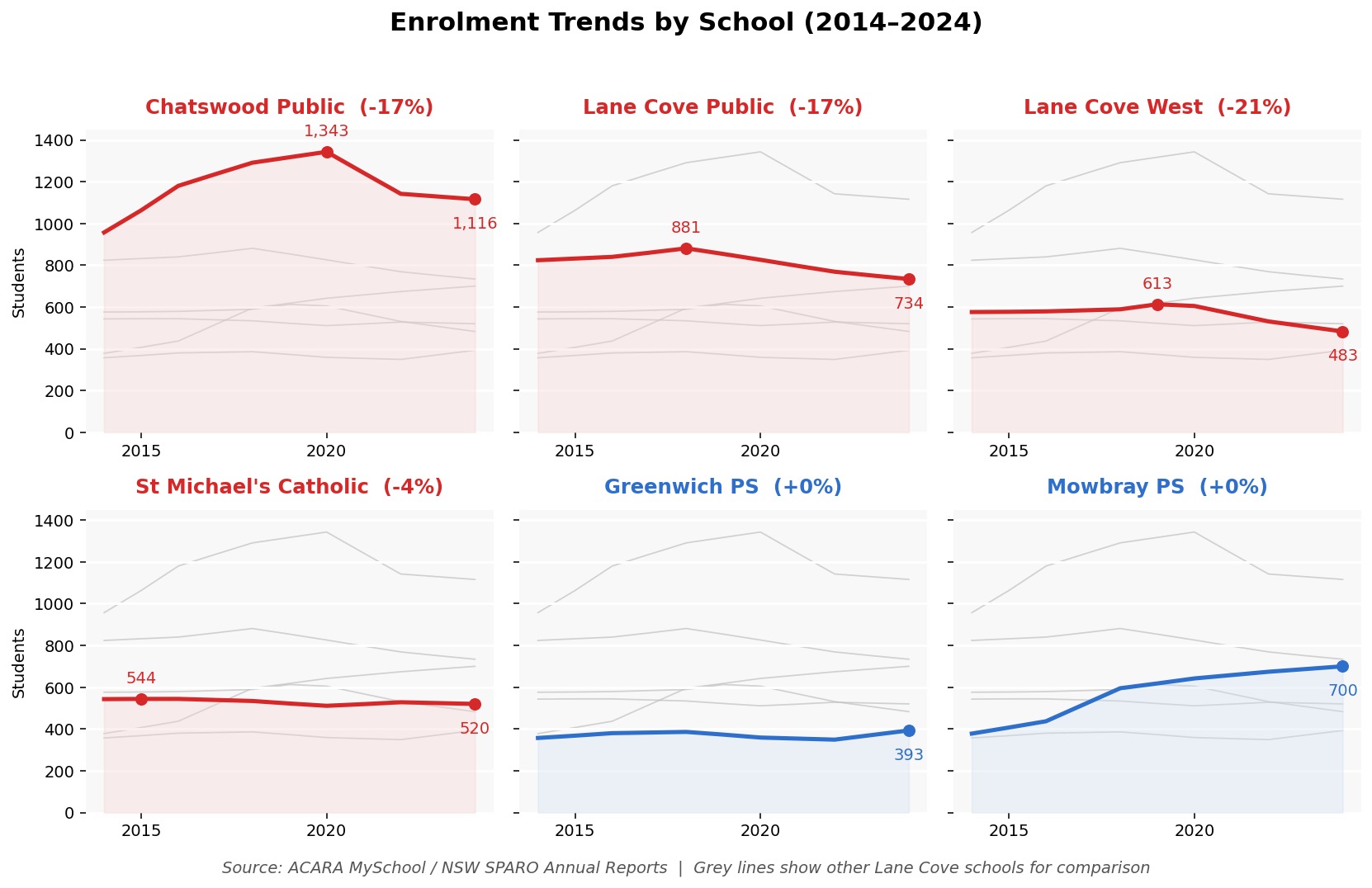 The data shows a clear pattern: most schools experienced strong growth through the mid-2010s, plateaued around 2018–2020, and have been declining since. The timing aligns with the peak NSW birth cohorts of 2013–2016 passing through primary school, followed by smaller cohorts entering behind them.
It’s Not Just Lane Cove
To test whether this is a Lane Cove problem or something wider, we analysed enrolment data for 15 public primary schools across the surrounding LGAs — Willoughby, North Sydney, Mosman, Hunters Hill, and Ryde.
The result: 14 out of 15 schools are declining from their peak enrolments. Some of the steepest drops are outside Lane Cove entirely — Cammeray PS has lost 32% of its peak enrolment, Mosman PS and Neutral Bay PS have each lost 30%, and Gladesville PS has lost 33%.
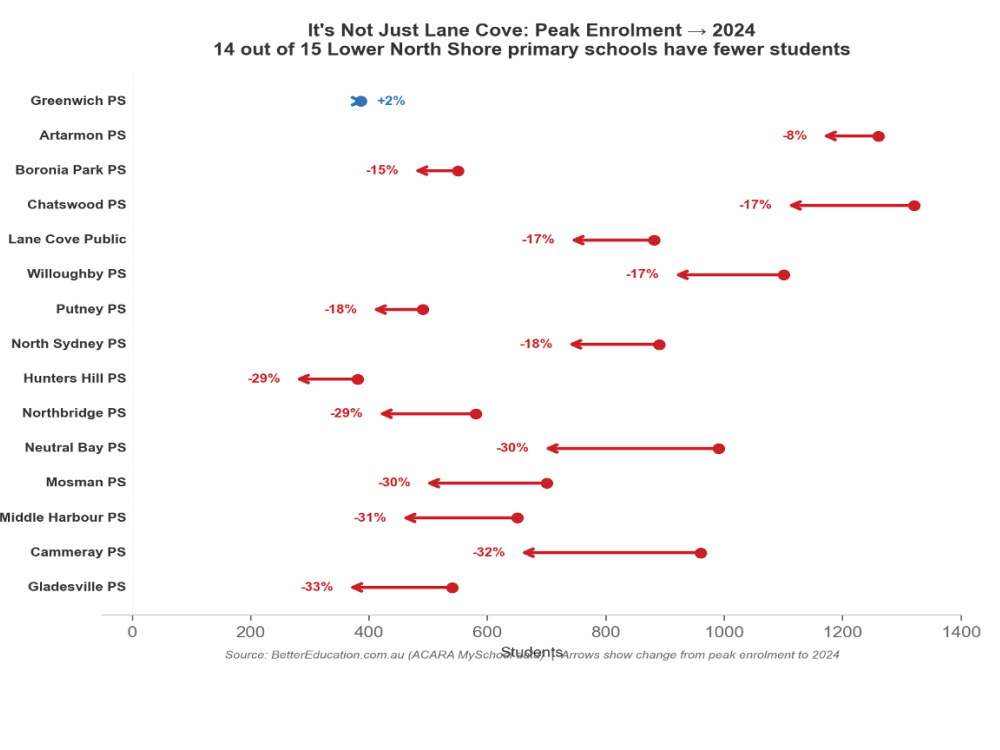 Lane Cove’s decline of 17–21% is actually milder than many neighbouring areas. This is not a local anomaly,
it is a lower North Shore-wide demographic shift.
In December 2022, the previous State Liberal Government released a tender seeking a developer to construct a mixed-use precinct featuring a new 1,000-student public primary school and public open spaces at the Chatswood Dive Site.
As at February 2025, the Budget Estimates identified the State Government decision to not proceed with a school over the Chatswood ‘Dive Site’.
The Environmental Impact Statement for the proposed development site (without a school) states:
“A meeting was held with the Department of Education on the 14 October 2025 regarding local need for infrastructure and impacts of proposal on future demand. DoE modelling including known SSDAs and cumulative impacts from strategic planning such as Chatswood CBD strategy. In addition, Department-led projections indicate a decrease in demand considering a range of factors including aging in place, decreased immigration, and decreased number of children per family. It was also recognised that upgrades to Chatwood Public School, Chatswood High School…”
The Kindy Pipeline: What’s Coming Next
Kindergarten enrolments are a leading indicator — today’s kindy class is your Year 6 class in seven years. The trends here are telling.
Total kindy intake across the five schools peaked at 518 (2018) and has fallen to 417 in 2024 — a 19% decline. But the headline figure understates the story at individual schools.
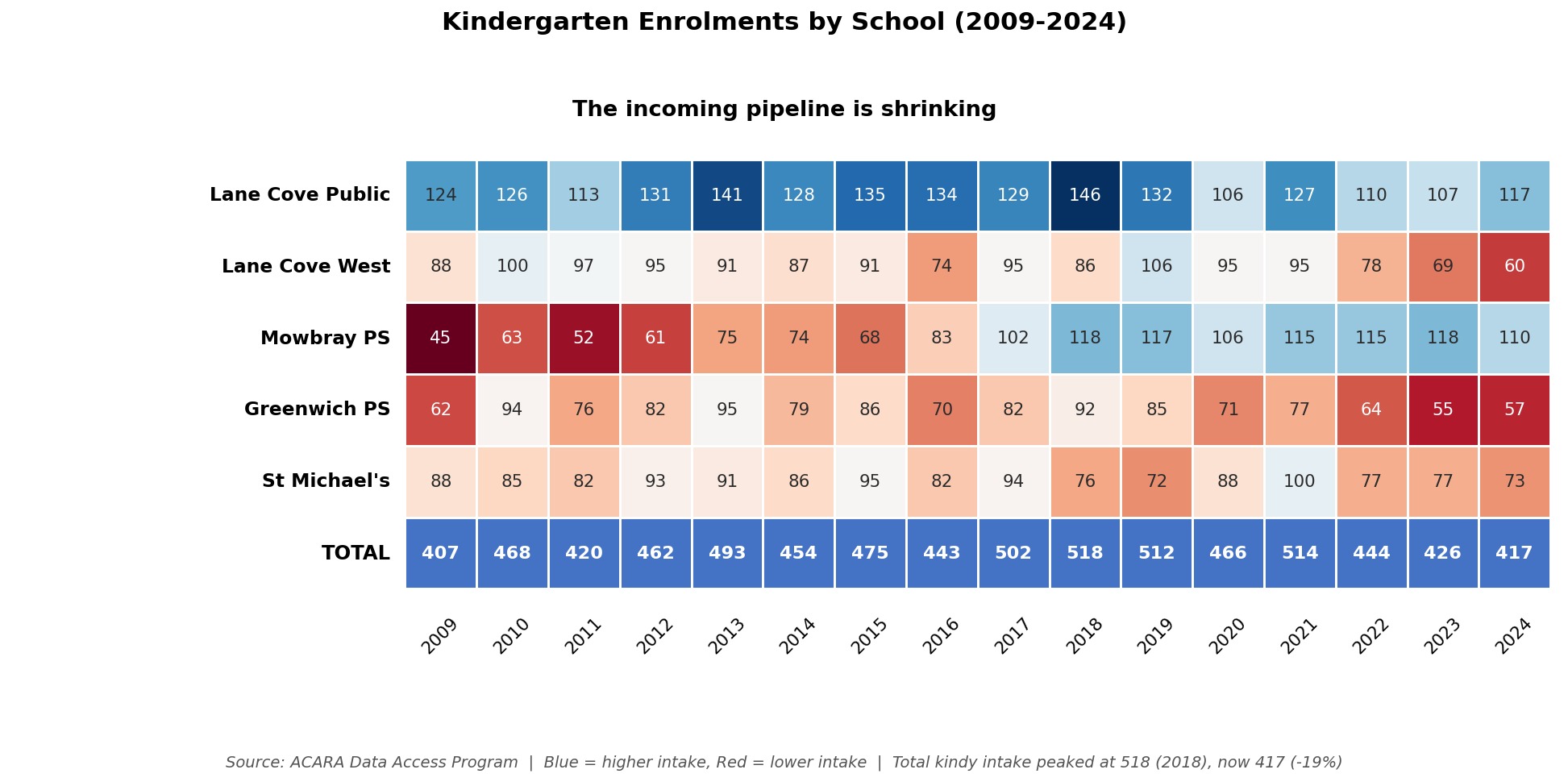
Lane Cove West’s Warning Signal: While Mowbray’s total enrolment continues to grow, Lane Cove West tells a different story. Its kindergarten intake peaked at 106 students in 2019 and has since almost halved to 60 in 2024 — a 43% drop. With fewer students entering the bottom of the pipeline each year, Lane Cove West’s total enrolment decline is likely to accelerate as those smaller cohorts replace the larger ones graduating out.
The children entering kindy in 2024 were born around 2018–2019, when NSW births began their sustained decline. This is the birth rate showing up in the data — fewer babies five years ago means fewer kindy students today.
Why Are Enrolments Falling?
Several converging forces explain the trend.
Fewer babies being born: Australia’s total fertility rate fell from 1.74 in 2018 to a record low of 1.48 in 2024. NSW births dropped 7.2% in four years (95,133 to 88,297). Lane Cove families with children average 1.7 kids. Nationally, Australia will have nearly 150,000 fewer primary-school-aged children by 2044 than previously forecast.
Young families leaving inner Sydney: The NSW Productivity Commission found Sydney lost a net 35,000 people aged 30–40 between 2016 and 2021 (though this period includes COVID-era disruption). The KPMG “Shrinking Suburbs” report (2024) found North Sydney–Mosman lost 1,278 residents between 2019 and 2023. Families are moving to the Hunter, Wollongong, and south-east Queensland, where a median house costs $300,000–$400,000 less.
The ITC newsletter
Never miss what's happening in Lane Cove
Free local news in your inbox every Wednesday night. Join thousands of locals.
Boom cohorts ageing through: School enrolments peaked around 2018–2020, aligning with children born in 2013–2016 (peak NSW birth years) passing through primary school. As these larger cohorts graduate and smaller post-2016 cohorts replace them, total numbers naturally fall. This “pig in the python” effect is visible in every school’s data.
Housing built for investors, not families: Lane Cove’s population grew 25% between 2011 and 2021 (31,510 to 39,438), largely through apartment development. But the assumption that apartments can’t house families is wrong — one in four Sydney apartments is home to a family with children (UNSW, 2024). The real problem is design: 81% of new apartments across Sydney are one- or two-bedroom, driven by investor preferences. A peer-reviewed study (Tyrrell & Wood, 2023) that specifically used Lane Cove LGA as its case study found families feel “stuck” in apartments not designed for their needs — housing that lacks the space, storage, and play areas families require.
Catchment redistribution: Some of the variation between individual schools may reflect catchment boundary adjustments rather than families leaving the public system. Mowbray’s growth alongside Chatswood Public’s decline could partly be a transfer effect within the same catchment area.
Are Families Choosing Private Over Public?
One question parents often ask is whether enrolments are shifting from public to private schools. At a national level, the answer is yes: ABS data confirms independent school enrolments grew 15.3% between 2021 and 2025, while government schools declined 0.4%. But the local story is more nuanced.
The growth in independent schools nationally is overwhelmingly driven by low-fee schools (around $5,000–$6,000 per year) in outer suburbs — typically faith-based K–12 schools in greater Western Sydney. It is not primarily driven by elite North Shore schools.
Locally, the large independent schools — Shore (K–12), St Aloysius’ College (Yr 3–12), and Loreto Kirribilli (K–12) — gained a combined 240 students over eight years. That’s roughly 30 students per school per year — about one extra student per class. These are capacity-constrained schools with multi-year waitlists. Meanwhile, Lane Cove Public, Lane Cove West, and Chatswood Public lost a combined 504 students over the same period. The maths doesn’t support “shift to private” as the primary explanation — the missing students weren’t absorbed by Shore or Loreto. Many were simply never born, or their families left Sydney.
There’s also a logical tension declining enrolments rests partly on housing affordability pushing families out. But Shore charges $28,000–$43,000 per year, St Aloysius’ $26,000–$30,000, and Loreto $25,000–$37,000. Two children at Shore from K–12 would cost approximately $1.1 million in tuition. Families genuinely struggling with housing costs are not switching to these schools — they’re leaving the area entirely.
On the Catholic side, small parish primary schools are under real pressure. St Philip Neri in Northbridge saw its enrolment decline to around 162 students before it merged with St Thomas Willoughby from Term 1, 2026. Holy Family in Lindfield also experienced enrolment pressures during this period. The Diocese’s “Shaping Tomorrow Together in Faith” strategic plan (August 2025) is actively consolidating smaller North Shore primary schools in response.
Meanwhile, Marist Catholic College North Shore — formed in 2021 from the merger of Marist College North Shore and St Mary’s Catholic Primary School North Sydney into a unified K–12 precinct — has grown nearly 14% in three years (1,310 to 1,490). The consolidation model appears to be working for the Catholic system, even as standalone parish primaries struggle.
What Does This Mean for Lane Cove?
The implications extend beyond school gates:
School funding: NSW public schools are funded on a per-student model. Fewer students means less funding for resources, staff, and programs. In 2024, NSW public schools saw a 1.25% budget cut linked to declining enrolments. Lane Cove West losing 130 students represents a significant real-dollar impact on a small school.
Shelved school builds: The NSW Government has shelved two planned North Shore school projects — a 1,000-place Chatswood Primary School (at the former Metro dive site, with over $25 million already spent on planning) and a St Leonards Education Precinct (preschool to Year 12). The government says “there’s not an urgent need right now.” But the same government is simultaneously fast-tracking thousands of new apartments in the Crows Nest/St Leonards corridor. That contradiction deserves scrutiny: will those new homes bring new families who need the schools that have just been shelved?
New housing may bring new families: The St Leonards South precinct will deliver approximately 2,000 new dwellings within the Lane Cove LGA. The NSW Government’s low and mid-rise housing reforms (effective February 2025) now allow terraces, townhouses, and manor houses within 800 metres of town centres — 1,487 Lane Cove properties meet the minimum lot size. These “missing middle” housing types are inherently more family-friendly than high-rise apartments. If delivered well, they could help reverse the trend.
The Silver Lining
It’s worth asking: is the decline actually a problem for the students who remain?
Many Lane Cove schools were bursting at the seams during the 2018–2020 peak — relying on demountable classrooms, managing overcrowded playgrounds, and dealing with the stress that comes with rapid growth. Lane Cove Public at 734 students today is closer to its 2014 level of 824 than it is to the overcrowded 881 of 2018.
Research consistently shows that smaller primary school classes produce measurable benefits: fewer disruptions, more instructional time, and deeper teacher–student relationships. NSW currently has approximately 1,800 teacher vacancies — fewer students per school may actually help schools that were struggling with staffing during the boom years.
The challenge for Lane Cove is not necessarily to reverse the decline, but to ensure that the schools and community infrastructure we have continue to serve families well whether there are 700 students or 900.
What Do You Think?
Have you noticed changes at your local school? Are your friends with young families staying in the area or moving out? Should the government have built those shelved schools? We’d love to hear your perspective. Leave a comment on our website or email us at [email protected]
All data referenced in this article is available for download as an Excel spreadsheet – click here.
This article was written by Anthony El-Khoury as a unpaid contributor. The views expressed are his own and not those of his employer.
Why Local News Matters
In the Cove delivers independent Lane Cove news every day — 100% free, with no paywall. We write for the community, from within the community. We are a proud member of LINA — the Local & Independent News Association, which supports small, independent publishers serving their communities with reliable, accountable local journalism.Local news strengthens community connection, keeps residents informed, spotlights issues that bigger outlets overlook, and holds local decision-makers accountable. When local news disappears, communities lose transparency, trust and shared understanding. Your support helps ensure Lane Cove continues to have a strong, independent voice.
Correction (21 April 2026): Kindergarten figures have been corrected. Thanks to reader Yelena for flagging.
Something seems wrong with the data. I know that in 2024 Mowbray PS had 100+ enrolments – not 45. They had 5 kindy classes with 20-22 students in each class.